
BLOG

Fly Fishing Tips: Mastering Tides to Catch More Permit in Belize
Belize. The name alone conjures images of turquoise seas, swaying palms, rum drinks, and the ultimate saltwater challenge: the permit. These elusive fish are considered the ultimate prize for many fly anglers, and a crucial skill to solving the riddle of to catch them, lies in understanding the subtle dance of the tides.
While permit are present in Belize year-round, knowing when and how the tides influence their behavior can dramatically increase your chances of landing these "black-tailed devils." It's not just about high or low tide, but the movement of the water that truly matters. In fact, permit can be found and caught at all stages of the tide cycle, if the water is “rushing." And the ‘rushing’ of the water across flats and through channels is what really get permit fired up and feeding.
Belize Permit Fishing: Decoding the Tidal Advantage
Belize. The name alone conjures images of turquoise seas, swaying palms, rum drinks, and the ultimate saltwater challenge: the permit. These elusive fish are considered the ultimate prize for many fly anglers, and a crucial skill to solving the riddle of to catch them, lies in understanding the subtle dance of the tides.
While permit are present in Belize year-round, knowing when and how the tides influence their behavior can dramatically increase your chances of landing these "black-tailed devils." It's not just about high or low tide, but the movement of the water that truly matters. In fact, permit can be found and caught at all stages of the tide cycle, if the water is “rushing." And the ‘rushing’ of the water across flats and through channels is what really get permit fired up and feeding.
The Power of the Push: Incoming Tides
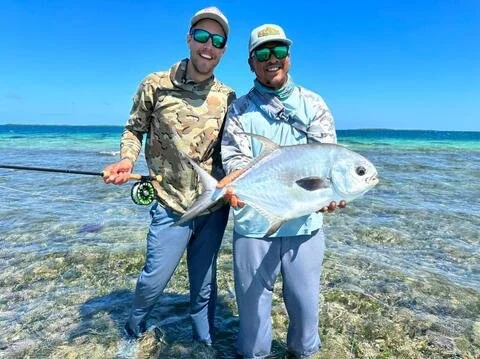
Ask any of our seasoned permit guides, and they'll likely emphasize the incoming tide as a prime feeding window. As the tide pushes in, it floods the knee-deep flats in our region, dislodging a smorgasbord of crabs, shrimp, and other crustaceans – the permit's primary diet.
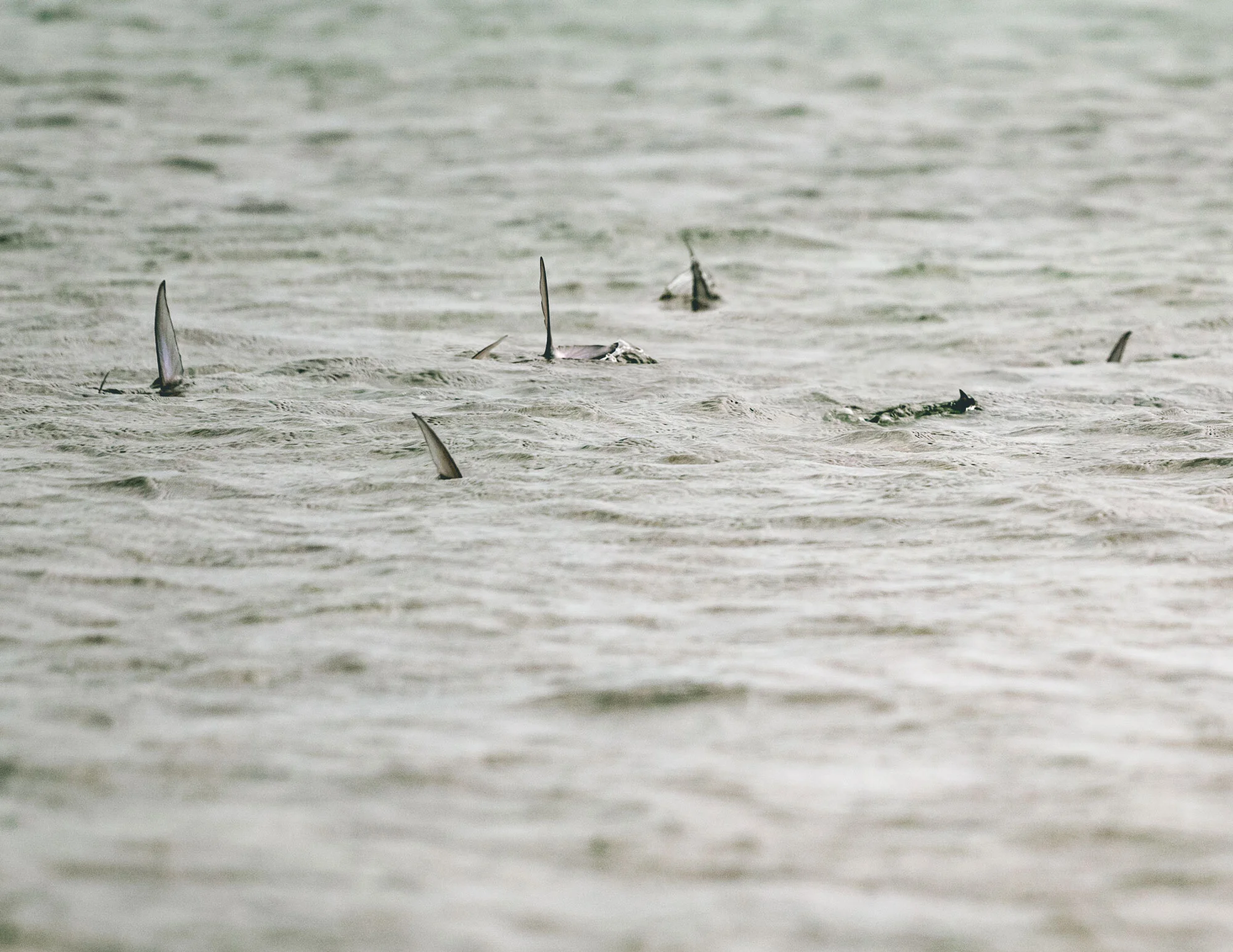
Tailing Heaven: This is when you're most likely to see those coveted black tails slicing through the water, waving their tails at you like a flag, from hundreds of feet down the flat. Permit, with their unique, plate-like bodies, will often tilt down, head-first, to root around in the bottom for their next meal. This "tailing" behavior makes them more visible and potentially less spooky, presenting an ideal shot.
The "Dinner Plate" Cast: When you spot a tailing permit, the goal is to land your crab or shrimp imitation within a "dinner plate" of its mouth – typically 1–3 feet ahead of the fish. This gives the fly time to sink and settle naturally in their feeding zone.
Focus on the First Few Hours: The first 1-2 hours of the incoming tide can be incredibly productive, as permit eagerly move onto the newly accessible flats.

The Retreat: Outgoing Tides
While the incoming tide gets a lot of glory, don't discount the outgoing tide. As the water recedes, it again "rushes" across the flats, dislodging crustaceans and moving currents into specific channels and along the edges of the flats. These current zones become the ideal place for permit to hunt their prey (and anglers to hunt them). Certain flats will fish better on an outgoing tide, than they will on the incoming tide.
Edges and Channels: Permit will often stage in deeper cuts and channels in the center of, or adjacent to the flats, as the water ‘rushes’ back out.
Early Outgoing Advantage: The first 1.5 hours of the falling tide can still be very productive, as permit make their final hunts for food on the flats before retreating to deeper water.

The Ideal Tide Window
What our guides look for, when expecting good fishing tides, is a predicted high tide from 7 AM until about 2 PM at the latest. This allows anglers to fish the best part of the incoming tide for the majority of the day.
One interesting note: Over the past two years, our team has been keeping track of the time of day they catch permit, and they’ve learned that very few permit are landed before 7 AM. The majority are landed between 9 AM and 1 PM. This is most likely due to the sun's position high in the sky. The high sun makes it much easier to spot the permit and deliver an accurate cast. The guides share that while they may get a lot of shots at permit in the early morning hours (5–6 AM), these shots are more like "guesses" because only the tail of the permit is showing, and most often result with spooking fish.
The Lunar Link: New and Full Moons
The moon plays a significant role in tidal strength, and for permit fishing, the new and full moon phases are often considered the most favorable. These "spring tides" create stronger water movement, which comes from a greater difference in the high tides and low tides.
Stronger Currents, More Food: The increased tidal flow during these phases sweeps more food into the current from the safety of the flats, stimulating an aggressive feeding response from permit.
Optimizing Your Schedule: If your trip aligns with a new or full moon, you're likely to experience the most pronounced changes tidal highs and lows. This will increase the likelihood of ‘rushing’ water over/around the flats.

Beyond the Tide: Other Factors
While tides are crucial, remember that permit fishing is a complex puzzle with many pieces. Other factors that influence permit behavior and your success include:
Weather: Calm, sunny conditions are ideal for sight fishing, allowing you to spot these mirror-like fish more easily. Strong winds or overcast skies can make spotting incredibly challenging. Note: the permit are actually more wary in overcast conditions. Likely because they can not see as far either.
Wind: Wind gets a special mention because it has the ability to completely negate the power of the incoming or outgoing tide. A north or north/northeast wind is by far the most challenging for productive fishing. As it relates to the tides, a north wind can push the tide so much that a "rush" of water from the incoming and/or outgoing tide never happens.
Water Temperature: Consistent warm water generally keeps permit active and feeding. Water temperatures that are too cold or too hot will limit the likelihood of seeing permit on the flats.
Flat Structure: Different flats will fish better at different tidal stages due to their depth and contours. Our seasoned team of guides knows where and when to be at the best spots for any given tide.
Weather in Other Parts of the Caribbean: Just because the weather is calm and sunny in Belize, doesn't always mean the tides will "do" their thing. If there is a powerful storm system elsewhere in the Caribbean, it has the potential to "pull" water to it, which can have a negative effect on the tides of Belize.
Tide and Weather Prediction Tools
Tide and weather predictions are rarely 100% correct or accurate, but if you use them as the best guess rather than hard facts, they can help you have great tides and great fishing. The moon phases are very accurately predicted, and if you choose to book your fishing trip to overlap 3–4 days before a new or full moon, and span for up to 7–8 days after, you're almost guaranteed to have some good days of fishing.
Tide Apps: There are a few affordable applications available that will have somewhat accurate tide predictions more than a week to ten days out. Our favorite is Nautide.
Weather Forecasting: Even professional weather forecasters can't predict the weather more than a week to ten days in advance with accuracy, so don't expect to know what the weather will be more than a few days before you travel. There are a number of different websites and apps available that will give you a "forecast" for different parts of Belize, and if you compare them, you might get as many different forecasts as you have apps. We use the following to help us predict the weather a few days in advance:
Moon Phase: The moon phase is a very reliable way to pick dates months, and even years in advance, to maximize the chance of having good/great tides to fish. We use this website to predict the moon phases: Calendar-12 Moon Phases.
Suggested Tide Windows
If you want to know our picks for the best tides, there are two ways to choose. You can choose your fishing dates based on the predicted tides or the predicted moon phase.

Tide Forecast: Use the Nautide app to look at the predicted tide for any given month, up to one year from now. Choosing to fish (so arrive a day earlier than your first day on the water) a high tide near 7 AM on your first day of fishing and not later than 2 PM on your last day of fishing will likely put you in the "prime" tide window.
Moon Phase Forecast: Use the website Calendar-12 Moon Phases to know when the new moon and full moon will happen each month. Then find fishing dates 3–4 days before the new or full moon, and 7–8 days after. This 10–12 day window (twice each month) will have the highest likelihood of "prime" tides.

The Permit Pursuit: Patience and Persistence
Ultimately, fly fishing for permit in Belize is a test of patience, persistence, and the ability to make a precise cast under pressure. Understanding the tides is a vital component of this challenging pursuit, giving you a significant edge in your quest for the elusive "ghost of the flats." So, pack your crab patterns, study the moon phases and tide charts, then get ready to experience the thrill of chasing permit in the stunning waters of Belize.
Are you ready to plan your Belize permit adventure, armed with tidal knowledge?
For more information call 800-313-1672 or email us at info@bluehorizonbelize.com

Fly Fishing for Tarpon in Belize: Our Guide to the Best Tarpon Fishing
What makes the tarpon, scientifically known as Megalops atlanticus, so captivating? Beyond their size and fighting prowess, they possess remarkable adaptations. Despite being a premier saltwater game fish, they can thrive in freshwater and brackish environments. Their primitive lung allows them to gulp air at the surface – a signal for anglers hunting for ‘rollers’ the creeks, rivers, or channels. Seeing a tarpon rolling on the surface is an invitation for a well-placed cast near where the last "roll" often results in an explosive eat.
Experience the Thrill: Tarpon Fishing in Belize - Your Ultimate Guide to the Silver King
Belize, a jewel in Central America, isn't just about stunning beaches and vibrant culture. For anglers worldwide, it's hallowed ground – the ultimate destination for tarpon fishing. The mere whisper of "Belize" evokes images of sun-drenched flats and the electrifying silver flash of a mighty tarpon erupting from the tranquil ocean surface with fierce aggression as you hang on to your rod for dear life. This isn't just fishing; it's an all-consuming passion, a relentless pursuit of a prehistoric creature, which can exceed 200 pounds, draws anglers from around the globe to some of the most fabled flats in the Caribbean.
The battle with a tarpon is not for the faint of heart, nor the weak of back nor will. Never underestimating their raw power and ballistic energy bursts. This is why many guides demand their anglers use an 11 or 12 weight rods, so they can land the fish quickly and unharmed. Once the hook is set, prepare for an epic duel marked by breathtaking aerial acrobatics and tug-o-wars of sheer brute force. It's common for fish over 60 pounds to peel line off your reel, screaming deep into the backing. Land one of these silver kings, and you'll understand the obsession – and the satisfying exhaustion that follows!

The Unique Allure of Tarpon
What makes the tarpon, scientifically known as Megalops atlanticus, so captivating? Beyond their size and fighting prowess, they possess remarkable adaptations. Despite being a premier saltwater game fish, they can thrive in freshwater and brackish environments. Their primitive lung allows them to gulp air at the surface – a signal for anglers hunting for ‘rollers’ the creeks, rivers, or channels. Seeing a tarpon rolling on the surface is an invitation for a well-placed cast near where the last "roll" often results in an explosive eat.
Prime Tarpon Habitats in Belize
Belize offers a diverse range of environments for targeting tarpon, each presenting unique challenges and rewards:
Flats and Ocean Lagoons: This is the quintessential tarpon fishing experience. Imagine drifting across shallow, clear ocean waters, often chest-deep, as your experienced guideexpertly poles the boat, and scans for these special fish. Their eyes scanning for the subtle shadow or movement of a cruising tarpon. In ideal conditions, these magnificent fish can be spotted from considerable distances, providing ample time for strategic positioning and fly presentation. Floating fly lines are the preferred choice here, allowing for "head-on" or "crossing" presentations to intercept patrolling fish. The famed tarpon flats of northern Belize – Miami Beach, Long Caye, and Savanna Flats – hold tarpon year-round, with peak season during the summer months.
Creeks and Rivers: In these often murky, brackish waters, blind casting becomes a highly effective technique. The invaluable knowledge of a local guide significantly increases your chances of success. They'll direct your casts to areas where tarpon are frequently seen rolling or have been consistently caught in the past. Intermediate full sinking lines or sink tip lines are your best tools in this environment. The tarpon inhabiting these waters are typically "juvenile" tarpon, ranging in size from a few pounds up to around 30 pounds.
River Mouths: Where the nutrient-rich brackish water meets the saltwater, river mouths become prime feeding zones for tarpon (and other species like snook and jacks). Similar to fishing rivers and creeks, these confluence zones attract large schools of baitfish. Targeting river mouths just after or during a flooding event can be particularly productive as the high waters flush out a bounty of forage fish. Keep a keen eye out for rolling tarpon and "nervous" water – indicators of feeding activity. Again, blind casting with an intermediate fly line is often the most effective approach.
Channels: The deep channels that carve through the coral reefs are prime locations for both resident and migratory tarpon. Here, it's not uncommon to find these two groups mingling. Typically, these "ocean" tarpon are larger, with encounters of fish under 40 pounds being rare, and trophy-sized fish easily pushing into the triple digits. Fishing during a tide "swing" – either nearing the peak of the outgoing or the incoming tide – is crucial, as moving water can motivate tarpon to “go on the feed”. Given the depth of many channels (up to 50 feet), a heavy sink tip fly line is essential. Our preferred choice for this type of tarpon fishing is the Rio Leviathan 500 grain sink tip.

Planning Your Belize Tarpon Fishing Trip: Timing is Key
Belize experiences distinct wet (June to November) and dry (December to May) seasons. While temperatures remain relatively consistent, these seasons significantly influence fishing success. While tarpon can be found through out the year, certain times of the year have increased likelihood of encountering them.
December – January: During the ‘winter’ months, remnants of North American cold fronts can bring clouds, rain, and wind (a strong "Nor'easter" in the States often translates to tougher fishing in Belize the following week), and temperatures can dip into the 70s, feeling surprisingly cooler. Your guide might even sport a puff coat and beanie! Weather can be the most significant factor during this time of the year. If the weather has been calm and clear for a few days, you will likely have great fishing for all species. But, if a cold front comes down from the north, it can be difficult to even find any fish (they must move to deeper water that has the temperature they prefer). However, extended periods of northerly winds can push baitfish into sheltered areas, attracting concentrations of resident tarpon and cruising snook. Finding a school of tarpon crashing a concentration of bait, is about the only silver lining to ‘cold front’ season.
February – May: This is the prime time for serious permit fishing, as water temperatures on the flats move in the ideal for permit. Bonefishing remains excellent, and tarpon fishing steadily improves. The first migratory tarpon typically arrive around the full moon in April or May, remaining in good numbers until early fall and when concentrations of bait fish are found, the tarpon are almost always right there with them.
June – August: Prepare for the peak of the tarpon migration! This is when the largest tarpon arrive in consistent numbers, with many exceeding the coveted 100-pound mark. Often light winds during this period enhance visibility and casting accuracy for all species. This is also the optimal time for a Grand Slam (catching a tarpon, permit, and bonefish in a single day), as permit flats remain productive, and the lack of angling pressure can make them less wary. Bonefish can be found with almost guaranteed consistency.
September – mid-November: If Tropical Storm or Hurricane is going to threaten Belize, it will most likely happen in this window. But don’t let that spook you off. While weather can be unpredictable, the fishing for tarpon, bonefish, and permit can be exceptional. On calm clear days, your chances of having great fishing for permit, tarpon and bonefish, are as high as any other month. But, when rain prevails, sight fishing can be challenging, making blind casting in rivers, creeks, and channels a productive strategy for landing quality tarpon.
Whether you're a seasoned angler or a newcomer to the sport, the allure of tarpon fishing in Belize is undeniable. It's more than just a fishing trip; it's an immersion into a world of powerful fish, stunning landscapes, and the unwavering pursuit of the Silver King.

At Blue Horizon Lodge, we are fortunate to have a resident school of tarpon frequently seen rolling just off the coral reef in front of the lodge, offering year-round opportunities. These resident fish are often joined by migrating tarpon, forming impressive schools of 50 or more. It is common for our guides to suggest going out for a quick fishing session before breakfast and our guests to have a tarpon to hand before the day has really begun.
Are you ready to answer the call?
For more information about fly fishing for tarpon at Blue Horizon Lodge, please email: info@bluehorizonbelize.com or call 1-800-313-1672

Mastering Permit on the Fly in Belize: 6 Essential Tips
Learn 6 essential tips for successful fly fishing for permit in Belize! Discover how to spot, cast to, and land these elusive fish. Expert advice from Blue Horizon guides and staff. These tips will help you catch a permit in Belize.
Fly Fishing for Permit in Belize: 6 Essential Tips
Fly fishing for permit is often considered the ultimate challenge in saltwater angling. These intelligent and wary fish demand precision, patience, and a keen understanding of their behavior. For anglers heading to the beautiful flats of Belize in pursuit of this prized species, mastering a few key techniques can significantly increase your chances of success. At Blue Horizon Belize, our experienced guides have witnessed firsthand what it takes to hook and land a permit on the fly. Here are six essential tips to help you achieve your goal.
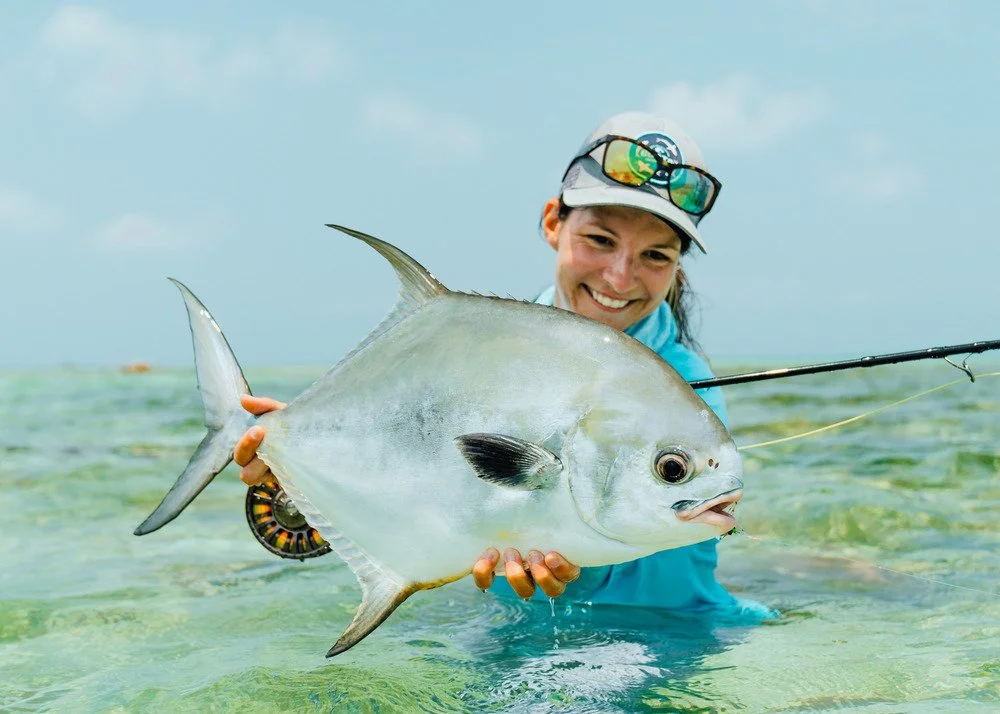
A permit landed in Belize at Blue Horizon Lodge.
1. Spotting Permit: The Art of the Hunt
When fly fishing for permit, a crucial first step is mastering the art of spotting permit in their natural habitat. This is often referred to as "hunting." Begin by expanding your field of vision, avoiding focus on any single point. Instead, systematically scan the horizon for "tailing" permit (easiest way to identify these fish) or look beneath the water's surface for "cruising" fish. A helpful technique is to look for interruptions in the natural patterns of the coral or turtle grass bottom or a break in the pattern of the water's surface – these "breaks" in the ocean's rhythm can signal a permit or school of permit. If something catches your eye, quickly focus in that direction to identify the source. The initial sighting of both tailing and cruising permit can be subtle. Try scanning from left to right (or right to left), starting close to the boat and gradually extending your gaze further. Repeat this process methodically.
PRO TIP: Polarized glasses are indispensable for this, so we'll assume you have a good pair. While wearing them, try slightly tilting your head from side to side, at an diagonal. This shift can enhance the polarization effect and improve underwater visibility, especially during the lower light conditions of early morning and late afternoon/evening.
2. Never Lose Sight: Tracking Permit in the Flats
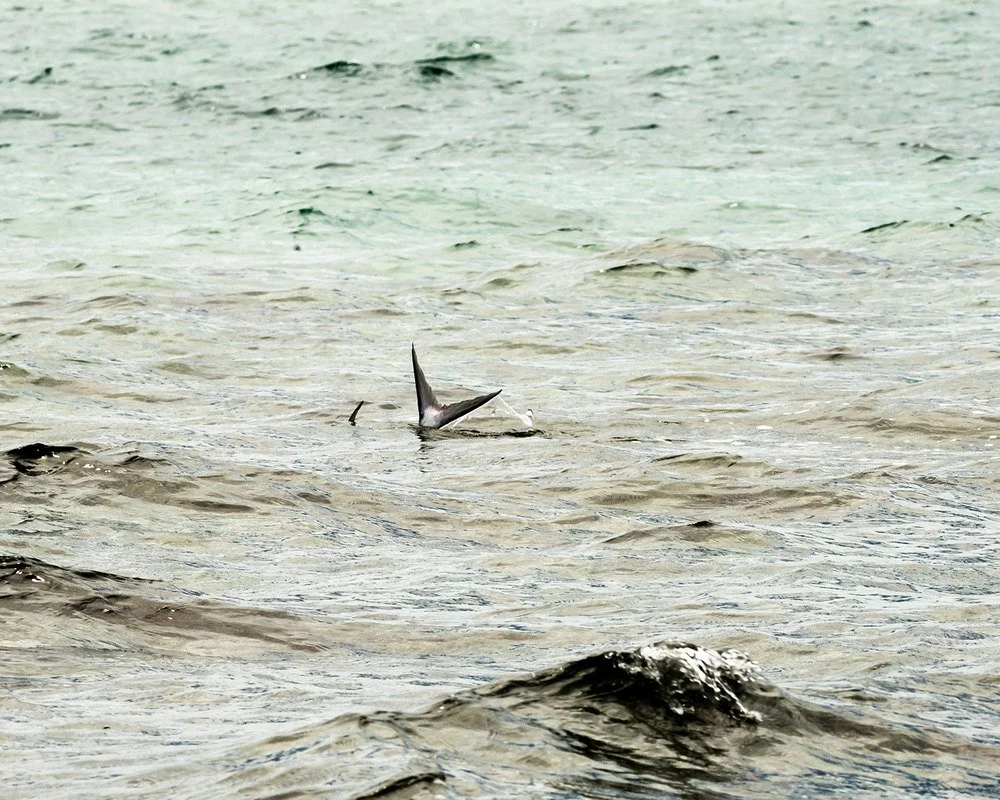
A permit tailing in Belize.

The break in pattern of the water you are looking for.
Once you successfully spot a permit that is tailing or swimming, resist the urge to look away. These fish possess an almost ghostly ability to disappear. One moment they might be clearly visible, and the next, with a swift kick of their tail or a subtle shift of their body, they are gone. If you lose sight of the fish, use your best judgment to anticipate its movement. Consider its swimming speed and direction, and focus your search on where you believe it might have gone. If you observed it swimming in a specific direction at a certain pace, look further out along that path. Often, they will reappear right where you anticipated them to be.
3. Accuracy Over Distance: Effective Casting for Permit

Casting with accuracy increases your odds of catching a permit.
Many anglers believe that catching a permit on the fly requires exceptionally long casts, often thinking they need to reach distances of 70-80 feet or more. However, the reality is that precise fly placement is far more critical than casting distance. Accuracy is the name of the game, and the most successful anglers in fly fishing for permit can deliver their fly with pinpoint precision. You might be surprised at how close to you or the boat these fish will swim, particularly when they are focused on feeding. If you can consistently cast within a 40-50 foot range with accuracy, your likelihood of landing a permit in Belize significantly increases.
Knowing precisely where to cast your fly is key. You need to present the fly close enough for the permit to see it, but not so close that the impact of the fly landing spooks the fish. Often, anglers cast too far away, fearing they will scare the fish. However, a fly cast too far is unlikely to be seen by the fish. The adage "Spook 'em or Catch 'em" holds true. Don't be afraid to cast closer to the permit than your initial instinct suggests. It's generally better to err on the side of casting slightly too close than too far away.
PRO TIP: If the permit is moving quickly, you'll need to cast further ahead of its current position, anticipating where it swimming to, in order to allow the fly enough time to sink – sometimes as much as 10 feet. Conversely, if the fish is tailing and actively feeding, casting a few inches from its face can often be the most effective approach. Trust your instincts to determine the best presentation.
4. Imitate the Prey: Fly Stripping Techniques for Permit
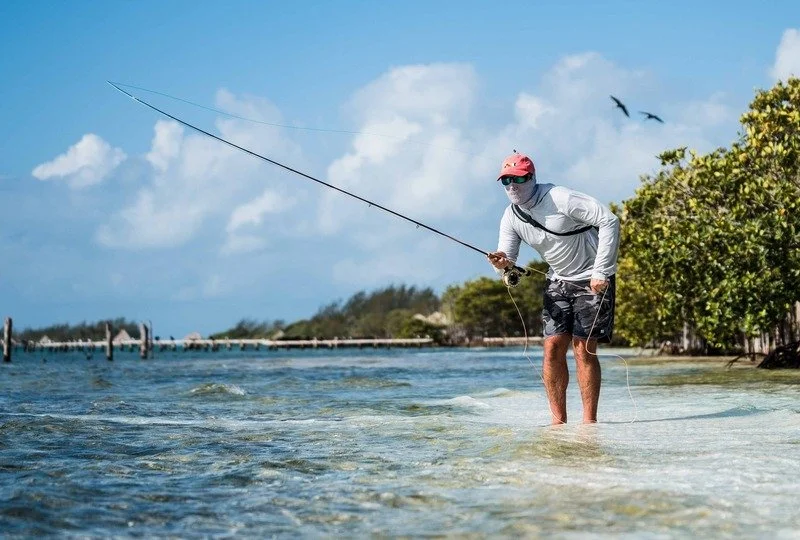
It is important to imitate the prey your fly represents to entice a strike from a permit.
Another common mistake anglers make when fly fishing for permit is stripping the fly too fast, too aggressively, and with too much movement. Our guide team has seen the catch rate of any of our guest improved dramatically once they are able focused on minimizing fly movement (at least while fishing with a grab pattern). Concentrate on keeping the slack out of your line so that any movement of the fly is subtle. More importantly, ensure there is no slack in the line, allows you to feel even the slightest take or if your fly is dragging on the bottom. This subtle approach is particularly effective when using a crab pattern, as crabs typically flee briefly and then try to hide from predators. If you are using a shrimp pattern, a slightly faster retrieve with a series of short, rapid strips often works best.
PRO TIP: Engage with the fish's behavior. Once you see a permit turn its attention to your fly, adjust your stripping action to mimic the natural movement of the fly you are presenting. For a crab pattern, be sure to incorporate pauses in your strip, allowing the fly to sink, imitating a crab fleeing and then seeking cover. When a permit shows interest in your shrimp pattern, you might increase the speed of your strip to simulate a shrimp panicking and trying to evade a predator. Be responsive to the fish's actions. If a permit chases your fly and then stops, experiment with increasing, decreasing, or even stopping your retrieve momentarily. Sometimes, a fish will inspect the fly multiple times before either eating it or rejecting it.
5. The Strip Set: Hooking Permit the Right Way

Don’t trout set!
When a permit eats your fly, remember this crucial rule: NEVER EVER EVER trout set (lifting the rod tip sharply and quickly). Instead, keep the tip of your rod pointed towards the fish and continue stripping the line at the same pace you were using to entice the strike. If the fish eats aggressively and turns quickly, you can release the line to avoid a break-off, as they often hook themselves in this scenario. Sometimes, a permit will eat the fly, but continue swimming towards you. In this situation, it's vital to keep stripping to maintain tension on the line; otherwise, the fish will likely spit the fly before you can achieve a solid hook set. A trout set, lifting the rod tip too early, will almost always result in pulling the fly out of the permit's mouth. By focusing on keeping the rod tip down and maintaining your retrieve until you feel the line pulling firmly from your fingers, you will significantly increase your chances of landing that fish. Once you feel the solid pull, then you can lift the rod tip and fight the fish as you would any other.
6. Breath: Staying Calm When Targeting Permit
Perhaps the most important piece of advice when fly fishing for permit is to control your emotions. These fish have a way of getting anglers incredibly worked up. However, the surge of adrenaline, dopamine, and cortisol can actually work to your disadvantage. Deep, slow breathing is the most effective way to maintain your composure. Inhale deeply to a count of 4 or 5, and exhale slowly to a count of 5 or 6, consciously focusing on relaxing your body as you exhale. Remember, it's just a fish! You've likely caught hundreds of fish before, and by keeping your heart rate steady, you'll make better, more accurate casts, and that permit is far more likely to inhale your fly as soon as it sees your fly!

Keep calm, with deep breaths, in order to make the best cast in these exciting situations.
Successfully fly fishing for permit in Belize is a rewarding experience that tests your skills and patience. By focusing on these six key tips – mastering the art of spotting, maintaining visual contact, prioritizing casting accuracy, employing effective stripping techniques, executing the strip set, and staying calm – you'll significantly enhance your chances of landing one of these magnificent fish during your next trip with Blue Horizon Belize. We look forward to helping you achieve your permit fishing dreams on the beautiful Belizean flats!
For more information about fishing with the team at Blue Horizon Lodge, you can email or call 800-313-1672

Epic Permit Quest in Belize: A Permit Triple Landed in Permit Alley
Kurt Long's story is one of dedication and perseverance. After numerous trips to Belize and Mexico, and countless casts, his 34th day of fishing for permit proved to be the turning point. The film captures the raw emotion and challenges of targeting these finicky fish, showcasing the highs and lows that every angler can relate to.
Fly Fishing for Permit in Belize
Have you ever dreamed of landing a permit on the fly? These elusive fish are the top bucket list catch for many anglers. Known for their challenging nature and the thrill of the chase, you won’t forget catching your first permit. In our film, “Day 24: A Permit Story” we follow Missoula fly fishing guide Kurt Long on his relentless pursuit of this dream in the legendary "Permit Alley" of Belize. Join us at Blue Horizon Lodge as we chronicle his journey, culminating in an extraordinary permit triple!
The Quest Begins: Fly Fishing for Permit in Belize
Belize is renowned as one of the world's premier destinations for permit fishing, and Blue Horizon Lodge sits right in the heart of it all. Located within the South Water Caye Marine Reserve, our lodge provides access to some of the most productive permit flats in Belize. But even in this angler's paradise, catching a permit is no easy feat.
Kurt Long's story is one of dedication and perseverance. After numerous trips to Belize and Mexico, and countless casts, his 34th day of fishing for permit proved to be the turning point. The film captures the raw emotion and challenges of targeting these finicky fish, showcasing the highs and lows that every angler can relate to.
Permit Alley: The Mecca for Fly Fishing Enthusiasts
"Permit Alley" is a name that resonates with fly fishing enthusiasts worldwide. This area, protected within the South Water Caye Marine Reserve, offers pristine flats and an abundance of permit. At Blue Horizon Lodge, founded by Belizean fly fishing legend Lincoln Westby, we pride ourselves on providing anglers with unparalleled access to this incredible fishery.
Our expert guides possess a deep understanding of the local waters and the behavior of permit. They share their knowledge and passion with every guest, helping them navigate the challenges and maximize their chances of success.
The Unbelievable Permit Triple: A Moment to Remember
One of the most remarkable moments in "Day 24: A Permit Story" is when the incredible happens, three permit are caught at the same moment from three different boats. Witness the sheer excitement as Kurt lands his first permit, along with two of his fishing friends land a permit too .
The film captures the magic of fly fishing in Belize and the exceptional experiences that await guests at Blue Horizon Lodge.
Blue Horizon Lodge: Your Ultimate Belize Fly Fishing Destination
If you're planning a fly fishing trip to Belize, Blue Horizon Lodge is the perfect base for your adventure. As the 2023 Orvis Endorsed International Fly Fishing Lodge of the Year, we offer:
Prime Location: Situated in the heart of "Permit Alley."
Expert Guides: Highly skilled and friendly guides.
Modern Amenities: Comfortable accommodations with AC, hot showers, and island-wide Wi-Fi.
Diverse Fishing Opportunities: Target permit, bonefish, and tarpon and more on our pristine flats.
Trip Options: Stay at our dedicated fly fishing lodge, or book full and half-day trips available from Hopkins, Placencia, and surrounding cayes.
Whether you're a seasoned angler or a novice, Blue Horizon Lodge provides an unforgettable fly fishing experience.
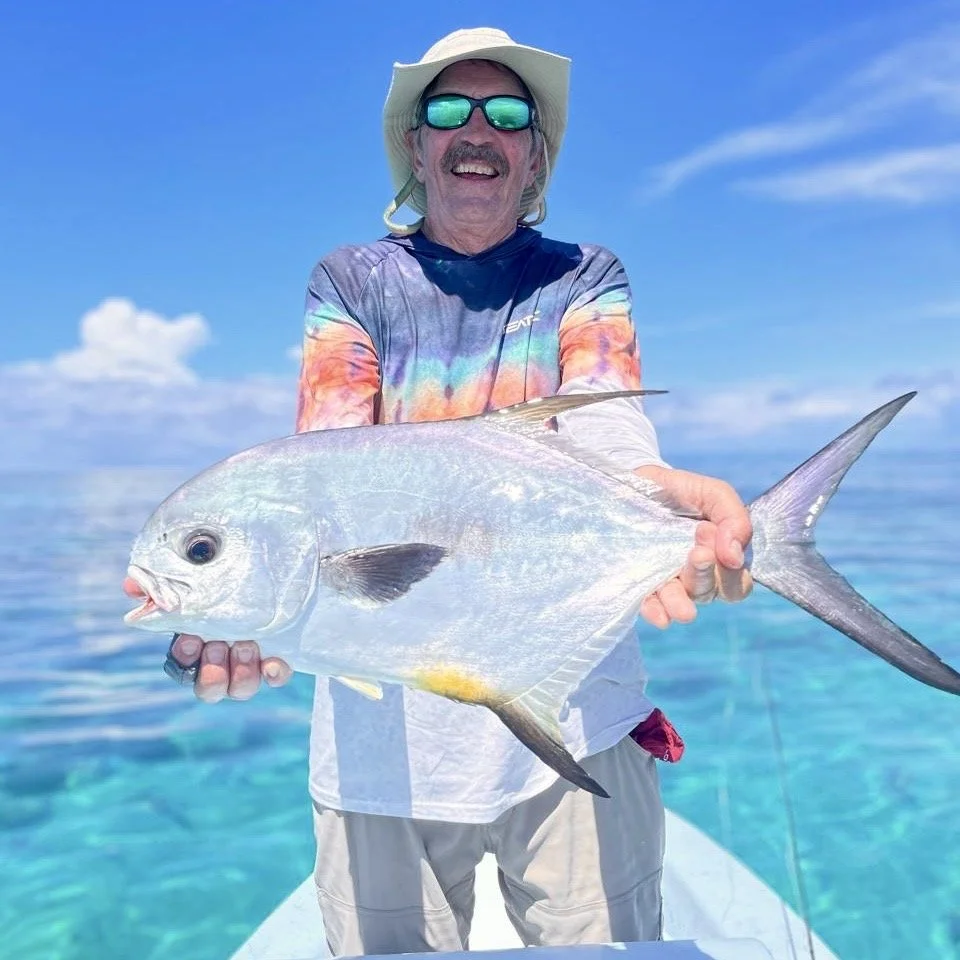
Fly Fishing in Permit Alley, Belize: An Angler’s Paradise
Permit Alley, as a region, is located in the South Water Caye Marine Reserve near the picturesque villages of Placencia and Hopkins. It is famous for its expansive pancake style flats - shallow water flats with deep water edges - that create the habitat permit love. Many of the flats in this region are wadable, with anglers easily able to navigate the ankle to mid thigh depths. The flats are often guarded on the eastern flanks by large coral heads - these can create an extra element of challenge, if a hooked permit swims to the safety of deeper water on the eastern edges of the flats. Many permit have been lost due to fly lines being wrapped or stuck in the coral.
Permit Alley Belize
Nestled within the turquoise waters between the villages of Placencia and Hopkins, in southern Belize, is the area known by the local fly fishing guides as Permit Alley. This region is also renowned among fly fishing enthusiasts for its perfect permit habitat and world-class angling opportunities. This extraordinary fishing destination offers a unique blend of pancake flats, ocean meadows of turtle grass, and stunning sections of the Meso-America barrier reef. Permit Alley is one the world’s top places to catch a permit on the fly.
Where is Permit Alley?
Permit Alley, as a region, is located in the South Water Caye Marine Reserve near the picturesque villages of Placencia and Hopkins. It is famous for its expansive pancake style flats - shallow water flats with deep water edges - that create the habitat permit love. Many of the flats in this region are wadable, with anglers easily able to navigate the ankle to mid thigh depths. The flats are often guarded on the eastern flanks by large coral heads - these can create an extra element of challenge, if a hooked permit swims to the safety of deeper water on the eastern edges of the flats. Many permit have been lost due to fly lines being wrapped or stuck in the coral.
The origin of the name Permit Alley is of some debate, even with the locals. For some, Permit Alley is a specific flat, not the entire region. For others, it is the area on the east and west sides of the Queen Victoria channel, that runs through the heart of the South Water Marine Reserve. Over the years more and more guides have begun to refer to the entire fishery as the fabled Permit Alley.
If the team at Blue Horizon Lodge was asked to define the boundaries of Permit Alley, the northern most point would be an unnamed flat, just north of Thatch Caye and the southern most point would be just north of Gladden Split. That’s approximately 25 miles north to south. At the widest point, there is about 10 miles between the barrier reef and the inner most flats. So there is approximately 250 square miles that encompasses Permit Alley. Literally, there are hundreds of flats for permit to cruise and feed on.
What Makes Permit Alley Special?
A Rich Biodiversity:
Permit Alley isn’t just about permit; it is also home to a variety of other species including other fly fishing targets - bonefish and tarpon. The eastern boundary is confined by the Meso-American barrier reef, which boasts some of the highest concentrations of marine diversity in the Caribbean. Countless other species including triggerfish, snapper, grouper, jacks, and barracuda, as well as conch and lobster take refuge in these waters.
The Perfect Permit Playground:
Permit Alley is nothing short of breathtaking, but the draw for a permit is the ideal habitat of safety and feeding grounds. Many of the flats in Permit Alley are narrow with deep edges. These deep drop offs can stretch to depths of 100 feet, offering confidence of a quick exist when exposed to danger on the knee flats.
Lots of Tailing Permit:
By far the biggest attraction to fishing in Permit Alley is the opportunities to hunt, cast, and catch tailing permit in shallow water. When contrasted with fishing for permit in other areas of Belize, Mexico, Cuba, and the Bahamas, the fishery in Permit Alley is relaxing. Often, permit are spotted from a great distance away, and tend to stay in the general area feeding. This allows the guide and angler team, to assess the best approach and stealthily get into the best position for a great presentation. Fishing to tailing permit in this region, is much less taxing that the rushed fishing that can be common in other permit fisheries.
When to go fishing in Permit Alley?
Fishing in Permit Alley can be productive 365 days per year, but certain times of the year are consistently more productive that other months on the calendar. In general, when the weather is “good”, meaning light wind (mostly from the east) and clear, sunny skies, the fishing will be great! Weather is not the only important factor to consider, the tides also play a crucial role for success in Permit Alley.
Best Months in Permit Alley:
Mid February through early September are the months that we tend to have the highest catch rates for permit. November is a great month too - commonly there is a week or two of the ‘best’ fishing weather of the year that occurs in November. By mid February, the winter’s cold fronts start to become less frequent, the water temperature warms, and permit move onto the flats in big numbers. March through May, the permit numbers are very consistent, and it is common for each boat to have 10+ good shots at permit per day, with some days our guides getting many more that 10. Late May into June, marks the start of the best time for a Grand Slam. The larger tarpon have migrated into our region and are quite consistently found, nearly everyday (NOTE: these large tarpon can show up as early as late March, but are nearly guaranteed to be around by the end of May). June through August is one of our team’s favorite times of the year in Permit Alley. The flats are nearly empty of angling pressure and the permit are much less bothered by our presence. As a plus, the reliability during the summer for tarpon (and bonefish) mean this is the interval of the year that we see the most Grand Slams caught.
Best Tides in Permit Alley:
It is very valuable to understand the tides and how they impact the productivity in this fishery. As an accepted rule of thumb, the best tides will occur 3-4 days before and after the new and full moon phases each month. The reason our team likes these 8-9 day tide windows, is because the high tide will range from around 7 am to 1 pm. This allows for our team to fish the maximum amount of the high tide window, both the incoming tide and the top of the outgoing tide. The flats in Permit Alley can actually go dry in areas during the lowest of the low tides, and if the fish don’t have enough water to get onto the flats, there is no way they can feed. Equally as important, or maybe more important to when the high tide occurs, is how the water moves across the flats. There is often a dramatic difference in the number of fish that come up to feed, when the tide is causing a current to “rush” over the flats. When the tide current is strong, we often see many more fish, and they feed much more aggressively. While the 3-4 day on either side of the new and full moon, is a great time to have the rushing currents, there are other factors that play into how the tide moves. Wind and barometric pressure have the biggest influence. A day with high pressure and light winds from the east is ideal. North winds are the worst and move the tide so that little to no current moves across the flats.
Planning a visit to Permit Alley?
Fly fishing in Permit Alley is more than just another fishing trip to Belize. It is an surprisingly comfortable experience at Blue Horizon Lodge, while not out on the water in one of the world’s most productive permit fisheries. Our lodge offers anglers quick access to some of the most famous permit flats in the region: Home Flat, Umbrella Flat, Pan Reef, Permit Paradise, Will Bauer’s Flat, Channel Caye, Elbow Caye, and many more are only 10-15 minutes by boat.
Each of the 5 guest rooms are furnished with two full sized, extremely comfortable beds, air conditioning, private bathroom with hot water showers, and plenty of room for all the gear you travel with.
Our island is a modern oasis, with island wide, high speed internet. You’ll be able to stay in as much or as little contact with the “real” world as you want. Some anglers who join us, tell their teams back at the the office that they’ll be ‘off grid’ during their stay. Other anglers, take advantage of the connectivity to stay in touch and work during their fishing vacation.
The menu at Blue Horizon Lodge incorporates local classics combined with savory worldly favorites that include seafood with each meal. All our fishing packages include all the local beer and spirits you care to indulge in, with plenty of mixers… hard to beat an ice cold Belikin at the end of a great day of fishing!
For more information about booking a stay at Blue Horizon Lodge and fishing in Permit Alley, email info@bluehorizonbelize.com or call 800-313-1672 or Book Now.

Lincoln Westby - 2022 Orvis Lifetime Achievement Award
During the recent, annual get together for Orvis Endorsed operations from around the world, our founder and head guide (yes… even at 81, he is still guiding daily), Lincoln Westby was honored with the Orvis Company’s Lifetime Achievement Award.
During the recent, annual get together for Orvis Endorsed operations from around the world, our founder and head guide (yes… even at 81, he is still guiding daily), Lincoln Westby was honored with the Orvis Company’s Lifetime Achievement Award.
During the awards ceremony, Simon Perkins, President of Orvis, had this to say about Lincoln:
“The Orvis Lifetime Achievement award is presented every year to individual who has meant so much to this industry over the course of their lives. These are people who have shaped this profession in ways that leave a lasting legacy on customers, peers and other professionals, natural resource, and more. Past winners have included legends like John Kowalski, Doug Gibson, George Hunker, Carolyn Parker, Matt Libby, Sandy Moret, Lonnie Allen, and Paul Roos.
In reading that list, “legends” certainly feels like an understatement.
I am honored to announce this year’s recipient is Lincoln Westby. Lincoln, as many know, is one of the most iconic individuals in world of saltwater fly fishing. I’ve been lucky enough to be on bow of his boat, and you can feel it when you are standing up there - his knowledge, perspective, care and love of the resource, of the next generation of guides, of this industry. But let me tell a little about his story.

Photo: https://instagram.com/doug.garvey?igshid=YmMyMTA2M2Y=
He was born on the water. Literally. His father was a lighthouse keeper on a tiny little island 30 miles from Belize City. His mother went into labor on the island and the family tried to make the trek across the open sea. Apparently even pre-birth Lincoln knew he was at home on the water and decided to enter this world before they reached dry land. (Lincoln, your mom must have been a hero!)
Early on, Lincoln worked in the kitchens for some of the first tourist hotels and lodges in Belize, using culinary experience he had previously acquired when traveling Europe while in the British Army. Through this work he got exposed to sport fishing, and then specifically fly fishing, which was not popular in Belize at the time. He became intrigued. He also heard about how permit were one of the most challenging species to catch. This intrigued him as well. Combining both was an ultimate challenge that called his name. and he became one of, if not the first to pursue permit with a fly in Belize.
He soon became a guide and started a career guiding at what have become some of Belize’s most renowned lodges in saltwater fly fishing. The Bauer crab, one of the most famous crab patterns for permit fishing, was developed by Lincoln and Wil Bauer on Lincoln’s boat. In 1997, he and his wife opened Blue Horizon Lodge, which became known as one of the world’s premiere places to catch permit. His guiding career has spanned nearly 40 years and thousands of permit have been caught by fly anglers on his boat.
In terms of guiding, his resume is as impressive as they come. But, like the fellow legends in the sport, what he has given back over the years is even more impressive.
He has long been a leading advocate for permit conservation. He has been a guide’s representative with the Belize Tourism Bureau. He worked to promote and lobby for the Catch and Release law in Belize. That successfully passed and now all bonefish, permit and tarpon are protected in Belize. For two decades, he committed himself to leading grassroots discussions on banning gill nets. Earlier this year, after all of that relentless work, gill nets were officially banned.
After 40 years, he is still guiding as much as possible, but he is also putting in significant time passing on his knowledge and skills to the next generation of guides in Belize.
As I mentioned, his resume is as accomplished as they come. With that said, all you really need to know about Lincoln you can learn in a matter of seconds just talking to him. You’re unlikely to meet a person who is more gracious, friendly, willing to help others, always smiling, and respectful of everyone he meets.
Lincoln, thanks for being you, thanks for all you have given to us anglers and to all you have given the industry and the natural resource. Congrats on being the recipient of this year’s Orvis Lifetime Achievement Award.”
Congratulations Papa Linc!

Photo: https://instagram.com/arianstevens?igshid=YmMyMTA2M2Y=

When is the Best Time Fish in Belize?
The Best Time to Fly Fish in Belize is… Year Round!
Belize is lucky to have consistent fishing 365 days per year. Of course, certain months of the year will produce more fishing success than other periods on the calendar… but we’ll discuss that further shortly.
The climate in Belize is ideal for creating memorable fishing experiences on any date on the calendar. The temperature averages about 80 degrees Fahrenheit and rare sees temps over 100 degrees. Even during the "rainy" season, it is more common to have passing showers than all-day deluges, so rarely is the fishing day cut short by rain.
The Best Time to Fish in Belize is… Year Round!
Belize is lucky to have consistent fishing 365 days per year. Of course, certain months of the year will produce more fishing success than other periods on the calendar… but we’ll discuss that further shortly.
The climate in Belize is ideal for creating memorable fishing experiences on any date on the calendar. The temperature averages about 80 degrees Fahrenheit and rare sees temps over 100 degrees. Even during the "rainy" season, it is more common to have passing showers than all-day deluges, so rarely is the fishing day cut short by rain.
The flats of Belize are protected by the second-largest barrier reef in the world (now the longest living reef in the world), second only to the Great Barrier Reef in Australia. The Meso-American reef, as it is known, protects and natures the three most popular sportfishing species in Belize: the bonefish, the permit, and the tarpon. Tarpon and permit (to lesser extreme) tend to migrate up and down the barrier reef. Certain seasons produce better fishing cause there are just more fish around. For example, you’re much more likely to encounter a large tarpon (80+ LBS) in June than you are in January.
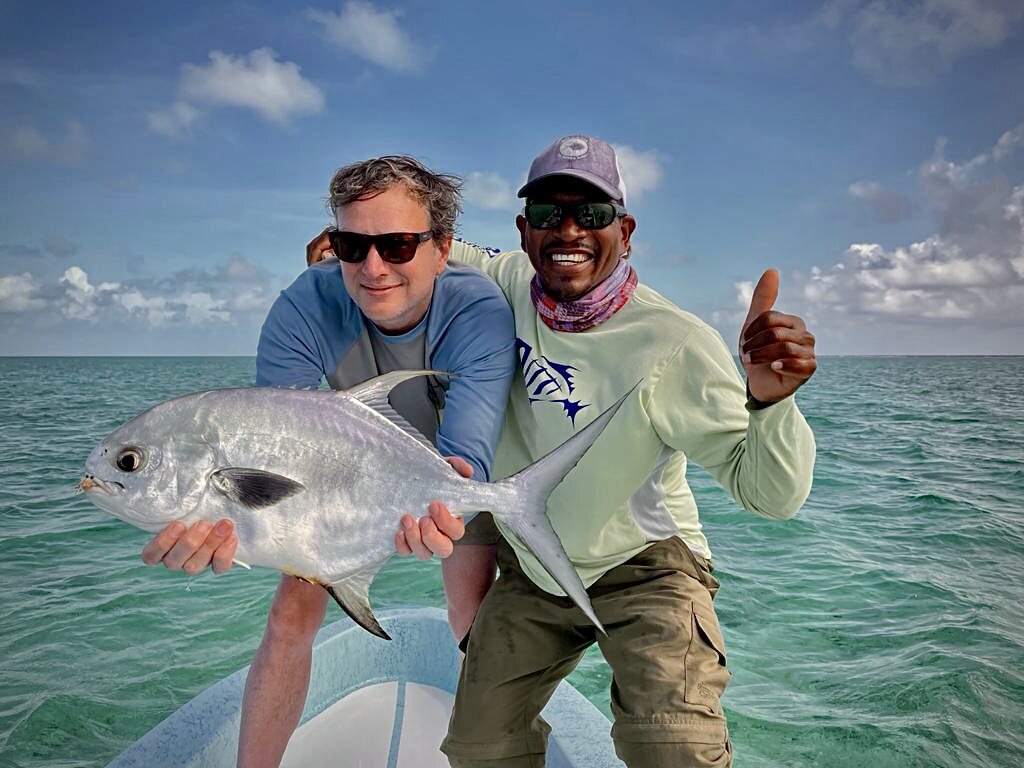
Belize’s rainy season traditionally spans from June 1st through the end of November. The rainy season doesn’t mean rain all day, every day. Rather it means small individual rainstorms that tend to move through quickly. The rainy season is often when we experience the best fishing of the entire year.
The dreaded “Northern” or cold front will most likely produce the most difficult fishing any time of the year. A cold front will bring cold rainy windy weather from the north. This cools the water temperatures on the flats, sometimes to undesirable temps that will get the fish from showing up in the shallow water. The north winds that characterize a “Northern”, have a dramatic effect on the tides too. The strong the wind from the north, the more likely the tide won’t move at the predicted times or levels. In certain instances, the flats can be blown dry. All the water will be removed from the flat.
The most common months for a “Northern” is mid-December through mid-February, but if one doesn’t happen during your fishing trip to Belize, the weather conditions are likely to be ideal and the fish will respond.

June is a great month to come to Belize to fly fishing for permit. This fish proves it!
Fly Fishing Opportunities by Month
In our part of Belize, bonefish, permit, and tarpon can be caught year-round. Some periods of the year are more likely to have better fishing for a specific species than other time frames. We’ve broken down the fishing by month. NOTE: different parts of Belize have slightly different seasons. This is what you can expect to see in the Southwater Caye Marine Reserve each month.
January: The new and full moon tide will create the most productive fishing for permit. Bonefish are a daily option. Tarpon schools are migrating and following bait. If you find them the fishing will be great… but they can be difficult to locate cause they move frequently. January is the most likely month for a dreaded “Northern”. The high winds can make fishing the flats more challenging in January.
February: Similar to January, in the first two weeks of the month. The best tides remain the new and full moon. Weather is the biggest factor this month. By mid-month, the chances of a “Northern” diminish dramatically. By mid-month, we expect to start seeing some of the best catch rates for permit of the year.
March: March brings the beginning of the most favorable time for fly fishing for permit in southern Belize. For the next 6 months, the permit fishing will be the best of the calendar year. Bonefish remain catchable daily. Permit are the primary focus, and all tide cycles will give the advantage to the angler. Tarpon continue to migrate with baitfish and when found will eagerly eat a fly. March can have higher winds, but it is not common to have a north front.
April: Bonefish are always an option. Permit fishing will remain great with the new and full moon phases. During the full moon this month, more tarpon will arrive in the region. These tarpon tend to be larger than the resident tarpon that swim the waters of South Water Caye Marine Reserve. The weather in April is settled and typically calm with little rain.
May: This is the hottest and often driest month of the year. It is common to have calm clear weather for weeks in a row. Bonefish are available. Permit fishing is very good, especially during the new and full moon phases. Tarpon are caught with daily regularity. Weather always the factor, but rarely this month.
June: Technically, June is the start of the rainy season, but don’t let this stop you from fishing during one of the best fishing months of the year. The rainy season is highlighted by quickly passing rainstorms. These storms can drop inches of water in less than 30 minutes. Luckily, they are most commonly isolated storms and won’t interrupt the fishing. June is the start of one of the best months for a grand slam: permit, bonefish, and tarpon on the same day. Again, new and full moon phases will bring the best fishing.
July: Nearly identical conditions as of June. One of the best months for fishing in Belize. Hurricanes can be a factor, we recommend you get travel insurance.
August: This is one of our favorite months of the summer season. The new moon in the first part of the month has consistently produced more Grand Slams than any other time of the year. Hurricanes can be a factor, we recommend you get travel insurance.

Permit caught in Belize in October.
September: By mid-month, the migrating tarpon have mostly moved to other areas of Belize or the Caribbean. Permit fishing will be good this month too, but we will start to recommend focusing on the first and last quarter moons, especially in the latter part of the month. Bonefish remain a daily possibility. This is the most common month to have a hurricane, please purchase travel insurance.
October: Weather and tides are the biggest challenges in October. The new and full moon tides are so high they create challenging conditions, as the flats will have too much water on them. The first and last quarter moon phases offer the best fishing in October. Tarpon are still possible, however, they are mostly the resident fishing (who often migrate throughout the region). Permit continue to dominate the focus, with bonefish being possible every day of the month. Hurricanes are still a potential complication during the first weeks of October.
November: At some point during November, the weather will slide into a pattern of calm clear weather, with little to no wind or rain. Very ideal conditions. Bonefish are still a daily target, with permit productivity picking up, especially during the ideal weather phase. Full and new moon phase is preferred. Tarpon can be found. As the month grows long, the chances of experiencing a “Northern” becomes more likely.
December: Some years the ideal weather spills over into December. When this happens, the fishing remains excellent. Same story for bonefish… daily. Permit and tarpon can be found, as long as the weather pattern is calm and settled.
Our experience supports that mid-February through the end of August each year offers the best fishing of the calendar year. November has a ‘sweet’ some for fishing too. September and October can produce great fishing, but not as consistently. December and January have the highest likelihood of weather affecting the productivity of your fishing trip.
Still want more information? Call us Toll Free: 1-800-313-1672. Or email us here: info@bluehorizonbelize.com

Orvis Endorsed fishing lodge in Belize
Blue Horizon Lodge is excited to announce that we are the newest Orvis Endorsed Fishing Lodge in Belize. For the past 5 years, our guide service has enjoyed the endorsement by Orvis. We served anglers the best fishing in the region as we lodged our guests at Thatch Caye, other sister resorts, and by offering day trips through numerous other resorts in Hopkins, the Placencia peninsula, and the cayes of southern Belize.
Blue Horizon Lodge is excited to announce that we are the newest Orvis Endorsed Fishing Lodge in Belize. For the past 5 years, our guide service has enjoyed the endorsement by Orvis. We served anglers the best fishing in the region as we lodged our guests at Thatch Caye, other sister resorts, and by offering day trips through numerous other resorts in Hopkins, the Placencia peninsula, and the cayes of southern Belize.
In 2021, multiple site visits by trusted members of the Orvis family, yielded expectational reviews of the experience at our newly rebuilt lodge. The guest room facilities, the lodge, the food, and the service were all highlights of the reviews. Of course cooperative fish helped too!
The newly rebuilt lodge sits on the same foot print of Lincoln’s original lodge on the island of North East Caye. Our rebuild was done with an effort to retain the “fish camp” feel of the original Blue Horizon while adding the necessary updates that today’s traveling anglers requires.
Highlights of the rebuild include:
Five - Air conditioned guest cabins, 2 full size beds, rod racks and shevles
Spacious bathrooms
Hot showers
Both purified water tap water safe for drinking (desalinated water from the tap)
High speed internet though our the island (15+ Mbps)
Open air main lodge/lounge area
All inclusive packages - DIY bar
Onsite laundry
Guides stay on island - they are ready to fish to capitalize on the best tides.
Why is the Orvis Endorsement important?
What does it mean to be Orvis Endorsed, and why is that important? The Orvis company has been endorsing fly fishing guides, outfitters, and lodges that meet their standard for being a world class fly fishing operation. This standard ensures the guests of an endorsed operation will encounter best in class service and facilities in the best fisheries around the world.
Acceptance into the endorsement program is determined by a number of factors such as resources, facilities, experience, customer service, and references. Each endorsed operation is visited and under goes a review based on a specific check list. This check list is in place to ensure guests of the endorsed operation will encounter unparalleled service, respect for natural resources, and an experienced, professional staff, in the safest manner possible.
The owners and staff of Blue Horizon Lodge are extremely excite to be recognized as the newest Orvis Endorsed Fishing Lodge. We look forward to meet the standards expected of us and beyond.
We’ll look forward to see you at the new lodge soon!
To book your next fishing vacation at Blue Horizon Lodge email us or call 800-

Lincoln Westby Celebrates 80 Years!
The founder of Blue Horizon Lodge and legendary permit fishing pioneer Lincoln Westby is celebrating his 80th birthday on January 4th 2021.

Birthday Alert!
The founder of Blue Horizon Lodge and legendary permit fishing pioneer, Lincoln Westby is celebrating his 80th birthday on January 4th 2021.
To honor Lincoln, we need your help. Please consider sending Lincoln a personalized birthday wish via cell phone video. It can be heartfelt or funny. The more we get the better!
We will create a compilation video of the greetings and that video will be shared with Lincoln at his Birthday Party in early January.
The best way to share a birthday wish, is by creating a video on your cell phone, then send that message to us. If you want to participate please click the link below (Be sure to have your video message already recorded), then simply follow these instructions from your phone:
Click this link: https://wetransfer.com/?to=info@bluehorizonbelize.com
Click “Send a file?”
Add the video, leave message if you would like
Choose the option “Send an Email” and enter info@BlueHorizonBelize.com
You’ll get an email with an access code to enter. After you enter the code, the file will be uploaded.
The deadline for sending in your video is December 28, 2020. If you have any questions, please call us at 800-313-1672 or email us at Info@BlueHorizonBelize.com
Belize Entry Requirements 2020
View a step by step guide of arriving in Belize in 2020. Includes an overview of COVID-19 protocols and Belize entry requirements. Belize opened October 1, 2020 to international travelers staying at Gold Standard Approved hotels.
Traveling to Belize, a Step by Step Guide of COVID-19 Protocol
Most recent updated found here.
Are you considering a visit to Belize soon?
Concerned about the entry requirements? Don’t be! The entry process is much easier than it sounds.
The flight from Houston to Belize City was nearly full, which was a surprise. United sent a message the morning of the flight to let me know that the flight was nearly booked, and if I wasn’t comfortable with that, they would put me on a different flight with no change fees.
Of course, I wasn’t going to wait another day to get on the flats!
I got lucky. My row was the only one that didn’t have someone sitting in the middle.
I took the liberty to ask any friendly looking co-traveler the standard Q’s: Is this your first time to Belize? What part of Belize are you traveling to?
Most of the answers I received where from ex-pats who left Belize in the spring. They didn’t want to get caught in Belize if the pandemic erupted. Now with time and knowledge, most wished they had stayed. There were also a number of Belizeans repatriating home to Belize.
The most common other response to my inquiry from my fellow travelers was that they had rescheduled a trip planned for earlier in the year, often having rescheduled multiple times. They were as eager to finally get to Belize as I was!
Sadly, none of the 20 or so people I asked had booked their trip within the last month.
Also, it is important to note, that I was one of four other travelers who were obviously traveling to go fishing. The rod/reel bags and Orvis, Simms, or Patagonia clothing was my tip off. I did speak to one other angler who was headed to San Pedro.
The boarding process and flight was smooth. Nothing out of the ordinary for a trip down to Belize. The attendants handed out customs/immigration forms midway through the flight. Those still need to be filled out as usual.
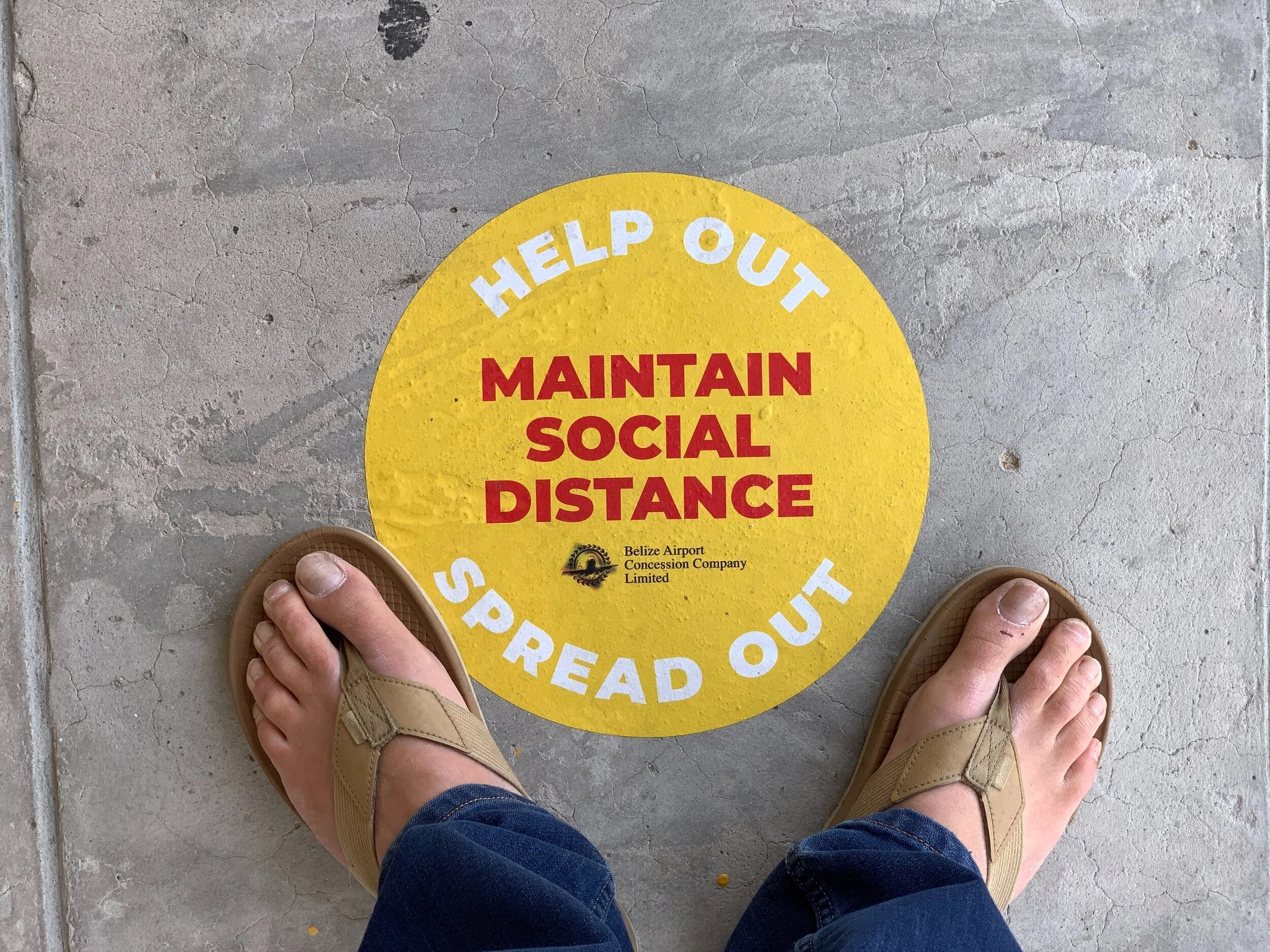
Once the plane landed in the Belize, the exiting process was very orderly. They called rows/sections. Each person exited doing their best to socially distance. As we departed the plane we were greeted by a number of workers, covered in PPE, who directed everyone on how to line up and be properly distanced. There were markers on the ground of where to stand. All other passengers followed the instructions well. The line moved slow… but that was expected. Everything was well marked and there was plenty of signage to help even a first time traveler navigate the arrival process.

The next steps to the entry process were extremely easy. Many workers helping direct everyone where to go, what to do, what to provide, and where to stand.
The first step is to go into a screening area.
(Sadly, this is the far end of the departure area, the same area that the famous Jet’s Bar is located. Sorry… no inappropriate photo ops with Jet on your next visit to Belize. If you know, you know.)
In the line, you’ll see stickers of where to stand for proper social distancing. Half way through the line, a representative from Belize Tourism Board will greet you and ask if you are a resident or a visitor. If you are visitor, you’ll get you tourist “ID”… a bright yellow wrist band. (If you’ve ever been to an ‘all inclusive resort” in Cancun, the wrist band may confuse you… this one won’t get you free drinks.)
The wristband will let everyone in Belize know that you are a tourist. Since there are certain areas a tourist will not be able to access without a guide, this bracelet will be an important identifier. Tourism is limited to Gold Standard Approved resorts, tours, and transportation. Visitors should not expect to have much freedom to leave the resort they choose to stay at. That is unless you are fishing, diving, snorkeling, or doing other tours with a Gold Standard approved tour operator.

After receiving my tourist wristband, I was ushered further down the line. Eventually, I was greeted by another set of screeners. They took my body temp (97.1… I run a little cool), asked if I had a COVID-19 PCR Test with proof that I was negative, then asked to see my QR code from the Belize Health App (that’s your ‘brand’ while in Belize).
Once I complied with all of these items, I was given a new piece of paper. This one was more important than I knew at that moment… it had the coveted ‘Green Stamp” on it.
I was then ushered outside into another set of lines. One with green dots to stand on. And one with red dots to stand on. You don’t want to be in the red dot line! The red dots mean that you did not arrive in Belize with a valid negative COVID-19 PRC test and that you will be given a test at the airport.


Luckily (again) I was in the green dot line. I was invited into the next and final screening room. I’m honestly not sure what this step was for… other than checks and balances. I gave them my test results, my passport, my QR code, and my cell phone number. Then they welcomed me to Belize!
From there I entered the familiar immigration lines. I was pleasantly surprised to see that there was zero line. I walked right up to the immigration booth. I said hello. The officer asked the normal questions. I answered. They stamped and gave me my passport.
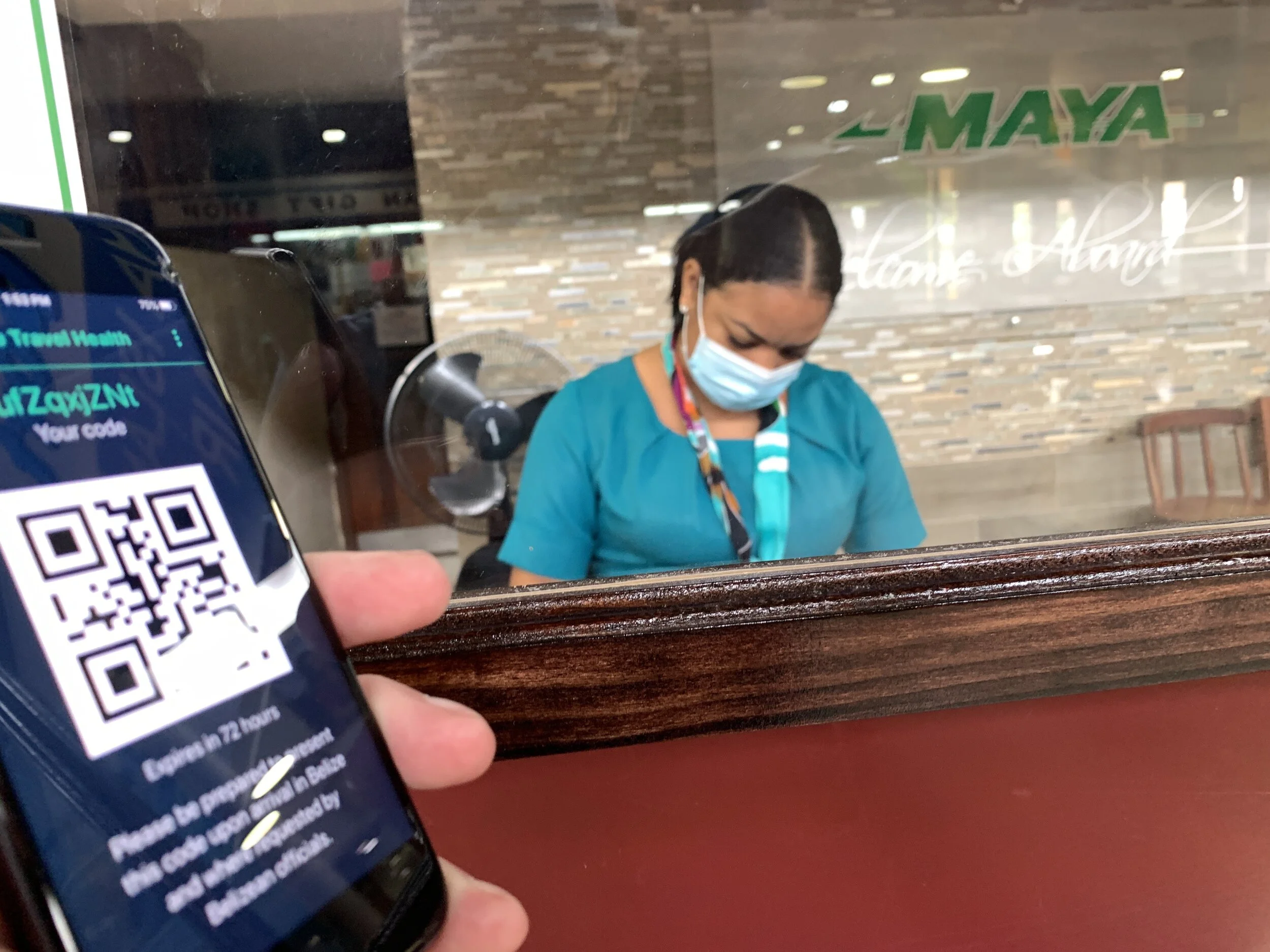
When I entered the baggage claim area, my luggage was waiting for me. I grabbed it. Cleared customs. Boarded my Gold Standard Approved transportation. And the rest is history.


Belizean Guides Need Our Support
There is no doubt that no one in the world has been uneffected by Covid 19 pandemic, but few have been as hard hit as the professional fishing guides on Belize. Belize closed the doors on international tourism on March 23, 2020, during the traditional peak of the most popular time for fishing in the country. While other locals around the Caribbean have either remained open or have reopened, Belize’s government prioritized the health and safety of its citizens over the shuttered tourism economy. And now the people, who rely on tourism to put food on the table, are feeling the deep pinch of no income.
There is no doubt that no one in the world has been uneffected by Covid 19 pandemic, but few have been as hard hit as the professional fishing guides on Belize. Belize closed the doors on international tourism on March 23, 2020, during the traditional peak of the most popular time for fishing in the country. While other locals around the Caribbean have either remained open or have reopened, Belize’s government prioritized the health and safety of its citizens over the shuttered tourism economy. And now the people, who rely on tourism to put food on the table, are feeling the deep pinch of no income.
It should be noted that just under half of the GDP of Belize comes from tourism.
The prime minister announced a (third) reopening date of October 1st, and we are excited to well a few ambitious anglers back to Blue Horizon. But we know it will take months, maybe even a full year, before the tourism industry fully recovers.
To assist the licensed, full-time guides of Belize, the American Fly Fishing Trade Association (AFFTA) and the Yellow Dog Community and Conservation Foundation (YDCCF) have initiated a relief campaign to provide anglers, industry businesses, and those who feel a strong connection to Belize a way to lend a hand to our Belizean fly fishing guides.
Please give the YDCCF site a visit and make a donation for your chance to help the guides of Belize.


Top 4 Permit Flies for Fly Fishing Southern Belize
Permit are regarded as one of the most challenging fish to catch in the sport of fly fishing. Their behavior, the often whimsical feeding patterns, is much less predictable than other flats species. This fact, coupled with their reliance on tides, is why permit have the reputation they have. Of course like all fish, they have their favorite foods; crabs, shrimp, and other crustaceans. For years, pioneers like Lincoln Westby, Charlie Leslie, and Will Bauer have designed flies to elicit the fish’s feeding instinct.
Permit are regarded as one of the most challenging fish to catch in the sport of fly fishing. Their behavior, the often whimsical feeding patterns, is much less predictable than other flats species. This fact, coupled with their reliance on tides, is why permit have the reputation they have. Of course like all fish, they have their favorite foods; crabs, shrimp, and other crustaceans. For years, pioneers like Lincoln Westby, Charlie Leslie, and Will Bauer have designed flies to elicit the fish’s feeding instinct.
Each permit fishery has a unique characteristic, and even some specific flats have certain flies that work better than others. It is also important to consider the best way to present the fly, some fly patterns should be striped, others are more effective when they get little or no movement fished on the ‘drop’. Remember, crabs don’t often flee from their predators. Instead, they hide, burying themselves in the sand and turtle grass.
Here is what we have found to be the go-to-flies on the flats of the best permit fishing flats in Belize.
Number 1: Bauer Crab Fly
The Bauer Crab is hands down the absolute must-have fly for fishing for permit in Southern Belize. Both variations of this fly will produce, in olive and tan. In the South Water Marine Reserve between Dangriga and Placencia, the tan version is the top producer. In the far southern reaches of Belize, the olive variation is the ‘go to’. Developed by the permit pioneer Will Bauer, the fly was honed in after many annual trips to Belize to fish with legendary permit guide Lincoln Westby. This fly has seen more fish brought to hand than perhaps any other crab pattern. The thick body mimics a crab very well and the Rubber Legs give it motion. This fly is best fished ‘still’ or with a slight amount of movement. The broad profile and stiff legs give this fly life like characteristics of a live still crab. It is very common for this pattern to be eaten as it sinks to the bottom, or when perfectly placed in front of a tailing permit. It is recommended to have this pattern in a variety of sizes based on conditions, recommended sizes include 4, 6, and 8.
Number 2: Camo Crab Fly
In Belize, permit eat lots of crabs. This will be evident when you spend some time on the reefs or pancake flats examining what lives underwater. If you flip a few rocks (just like you would on your local trout stream) you’ll see what the permit sees… and eats. One of the most common critters you will find is the small crabs. They range in color for dark green to near white. These multi-colored crabs are the food of permit (and to a lesser extent bonefish). Many of these crabs tend to be no bigger than a nickel, they have short but prominent legs. A normal crab pattern about the size of a quarter is two big, a solid colored crab doesn't look like the real thing. The Camo Crab has begun to give the Bauer Crab a run for the money, as a growing continent of guides is making the Camo their “go to”.
Number 3: Colby’s Casa Blanca Raghead Crab
In the past few years, many of the BHL guides have started using the tan Casa Blanca crab more frequently, and with proven success. The lead eyes on this fly are smallish, making for easier casting, and the fly lands softly, lessening the possibility of spooking fish. This fly should be stripped to activate the rubber legs and to make it look alive. One of the most common shots you’ll experience on these flats are slowly cruising and feeding permit. When you are fishing in this situation, you’ll typically have the best success with a slow-moving fly. A less predictable shot, this situation requires the fly to be delivered close to the permit (but not on the fish). Leading the fish by 1-2 feet can be the most effective (it can also be the most likely to spook the fish off the flats) then a 1 count before stripping the fly.
Number 4: Mantis Shrimp Fly
One of our other favorite permit flies is Bob Veverka’s Mantis Shrimp. The long rubber legs give the fly a lot of movement and fish react best during a slow retrieve. One of the top features is the bead chain eyes. The lighter weight can be fished in shallower water along the reef edges. This fly works great with the cruising permit you often encounter feeding in muddy bottom flats or along the sargassum grass edges. This lightweight fly can be cast extremely close to tailing permit, with little fish of spooking them. Another bonus to this fly is the ability to cast at the unexpected bonefish school that maybe feeding on the same flats.
Southern Belize has long been known as the best permit fishing location in the Caribbean. The prime fishing area is very large ranging from the southern border north to Dangriga. The two most popular areas to fish are the Port of Honduras Marine Reserve and the South Water Caye Marine Reserve. Both offer, short boat rides to protected groups of small most uninhabited mangrove islands and pancake flats. Schools of permit; small groups, and singles feed on the mixed rocky and turtle grass flats. The Bauer Crab is hands down the go to fly for this part of Belize, but many other flies will seduce permit into feeding. Many permit in this region is attracted to sinking or still crabs. Casting your fly just inside the range of the permit’s vision is the best target. If they see the fly, they will undoubtedly move to inspect. Depending on what your guide says, either no movement or a slight twitch is the preferred method of enticing the fish to eat.
If you are armed with our four recommended flies, there will be fewer excuses for not connecting with the coveted permit. For those anglers who are new to the game, we’d like to offer a touch of wisdom; 1. Always trust your guide - if he says to use one of these patterns (or one not on this list), Fish it! 2. The fly only is 40% of the equation for success. 60% is finding the right fish. The ‘right’ fish will eat just about anything your put in front of it.
For more information about fishing in Southern Belize, please contact us at info@BlueHorizonBelize.com or call us at 1-800-313-1672

Our Guide Boats: Fly Fishing from a Panga
All of the guides at Blue Horizon Belize use fishing boats called “pangas”. A panga is a Mexican style open fishing boat with a bimini top for shade and an outboard motor. Unlike a flats boat that might be common in the Bahamas or Florida, a Panga has larger sides that can withstand larger waves and rougher seas. Often times our fishing guides have to cross certain parts of the ocean where there is no reef with deep depths and these runs can have very choppy water if the winds are up. So with these pangas, the guides are able to safely boat through these areas.
All of the guides at Blue Horizon Belize use fishing boats called “pangas”. A panga is a Mexican style open fishing boat with a bimini top for shade and an outboard motor. Unlike a flats boat that might be common in the Bahamas or Florida, a Panga has larger sides that can withstand larger waves and rougher seas. Often times our fishing guides have to cross certain parts of the ocean where there is no reef with deep depths and these runs can have very choppy water if the winds are up. So with these pangas, the guides are able to safely boat through these areas.
Most all of our pangas are equipped with a front lean bar as well as a bimini top to provide shade from the intense Caribbean UV rays. They have a front deck casting area with ample spaces as well as comfortable seating for two people. The front casting area provides anglers a top level view to sight and hunt down fish. The guide will typically stand in the back of the boat after arriving at a flat and begin to pole the flats in search of catching a Belizean permit, bonefish, or tarpon.
Some of our reef fishing pangas are larger and can comfortably hold up to 8 people. But the fly fishing guides prefer to use the smaller ones as they can go in skinnier water more easily.

Trip Report - Thatch Caye Island Resort – Blue Horizon Belize
The moment your feet step off the panga and onto the landing dock of the breathtaking Thatch Caye Island Resort you are greeted by a fresh glass of ice cold watermelon juice prepared specifically for your private arrival. Pearly white smiles of the hospitality crew surround you. From that moment until you return back to the mainland, every wish and desire you have is accommodated at the all-inclusive island resort. The entire island only takes you 20 minutes to walk from one end to the other, it is complete with 15 rooms and can sleep up to 32 guests.
The moment your feet step off the panga and onto the landing dock of the breathtaking Thatch Caye Island Resort you are greeted by a fresh glass of ice cold watermelon juice prepared specifically for your private arrival. Pearly white smiles of the hospitality crew surround you. From that moment until you return back to the mainland, every wish and desire you have is accommodated at the all-inclusive island resort. The entire island only takes you 20 minutes to walk from one end to the other, it is complete with 15 rooms and can sleep up to 32 guests.
The resort attracts honeymooners from all over the world as it is complete with oceanfront penthouses and overwater bungalows, so there will be no shortage of drunken happy go lucky couples to laugh the evenings away with. The advantage to this is that while yes you will mostly come across a plethora of vacationing couples, you will be all alone in your fly-fishing quest for one of the most challenging sport fish of all time. Trachinotus falcatus. Otherwise known as the Permit.
Thatch Caye is centered in the heart of permit country. Surrounded by the world’s largest living reef, the Belize Barrier Reef you can literally cast to schools of tailing permit and not see another soul for miles past the horizon. One morning we just hopped on a couple of the community bicycles and peddled down to the north end of the island.
Stealthy as we could peering through openings in the hanging palms we spotted bonefish tailing just a rod lengths from the shore. Someone wake me up, it can’t be this easy… All along the west side and close to the overwater tiki bar thrashing takes and baitfish raining just above the surface for their lives echo throughout the night.
The water is alive with hunting barracuda, reef fish brilliantly strutting every color of the spectrum, and of course your game fish: bones, tarpon and permit.
Say for example not every person in your party wants to fly fish every day. No worries, your experience is completely designed by the interests of you and those who accompany you. Snorkeling, diving, lobster/conch hunting, basket weaving, kayaking, stand up paddle boarding, river boat tours, island crawl via a floating bar, body treatments, spa massage are all on the table. Evenings if you so desire can end with popping bottles on a stargazer’s cruise under the Belizean Night Sky. And again if all you came for is the fly fishing then you can literally fish till your heart’s content.
While we were there we had the incredible opportunity of fishing with the Permit Master himself. When you meet Lincoln Westby you have immediate innate respect for this man. A legendary Belizean fly fishing guide he was fishing for permit with a fly rod before the rest of the world knew what a permit was.
At 78 years of age, he was polling us around the flats as if he had just reached his prime, telling us fish stories from 40-50 years ago while slipping in life lessons of forgiveness, humility and well-being.
Lincoln is simply an immense wealth of knowledge that no video, book or article could ever fully convey. His kindness, patience and direction deemed him an absolute pleasure to spend the days fly fishing with and the words and stories he shared with us will not soon be forgotten. (Lincoln is the lead guide for Blue Horizon Belize, an Orvis Endorsed fly fishing outfitter that operates out of Thatch Caye Island Resort).
The island resort is well aware of the jewel of a location in which they are located when it comes to destination fly fishing so they have cleverly designed several of their cabanas to accommodate the visiting angler. At the end of a long day on the salt, all you want to do is shower and be cold right? Well, you just mosey yourself on down to your private quarters, hang your rods on the fly rod holders built right onto your cabanas deck, step inside and blast the AC.
You must, however, be very cautious of the beds in the angler cabanas…. I kid you not, the first night I slept there I awoke the next morning feeling as though I had slept for a week and subtracted 10 years of aging. A nap could turn into missing dinner and dinner at Thatch Caye is not something you can forgive yourself for if you miss.
The first night prepared by the Island’s private chef we had lobster that was caught that day from a rocks throw away. The food is thoughtfully and artistically prepared as the chef has the support of a crew of 5-6 servers, sous chefs and line cooks all with one goal which is to make sure that every bite is an invigorating experience.
I think that in itself is exactly what this Muy’Ono Resort envisioned when they designed this paradise destination. They pictured a glistening sunset and you walking barefoot, past the breezy palms on your way to a hammock, pina colada in hand and a smile from ear to ear reminiscing on a day of fly fishing that you won’t ever forget.
Article by Ruth Simms (@navajoflyfisher) on a recent Team Flylords trip down to Thatch Caye Island Resort while fishing with Blue Horizon Belize in the famed Permit Alley region of Southern Belize.
![River Fly Fishing in Belize [Snook and Tarpon]](https://images.squarespace-cdn.com/content/v1/55267a84e4b0410f3276ac29/1588199931719-72N4FSY37YICV0SOM41D/IMG_2868.jpg)
River Fly Fishing in Belize [Snook and Tarpon]
Many river systems in Belize drain right into the ocean and can provide anglers with some phenomenal sport fishing. Especially when conditions in the ocean are poor due to the weather. Many species thrive in these river systems but for fly fishers and sport anglers two species come to mind, snook and tarpon. Jack’s will also move into these river systems at times, they can be spotted busting bait at the surface and will often move very fast.
Many river systems in Belize drain right into the ocean and can provide anglers with some phenomenal sport fishing. Especially when conditions in the ocean are poor due to the weather. Many species thrive in these river systems but for fly fishers and sport anglers two species come to mind, snook and tarpon. Jack’s will also move into these river systems at times, they can be spotted busting bait at the surface and will often move very fast.
Typically, these rivers are very tidal influenced and also dependent on rain. During the dry season, the fly fishing can often be better as there is less freshwater and more saltwater in the rivers. This provides more suitable conditions for saltwater species like snook and tarpon to thrive in.
Similar to streamer fishing for bass or trout, fly fishing in these rivers consists of “blind casting” for the most part as these rivers have a dark green color providing not good clarity to sight fish. So typically casting to the bank and retrieving your flies is the standard technique. To increase your chances look for a structure like logs, rocks, and other hiding places where fish can ambush your fly. At times the fishing can be very slow and then all of a sudden the bite can turn on, very similar to bass or trout fishing back on your home river.
Snook Fly Fishing in Belize Rivers:
Snook may be considered the saltwater bass as they are very aggressive and eager fish that are very willing to take a fly. They range from a couple pounds to upwards of 15-20 pounds at times, but very rare. The standard tactics involve blind casting to structure throughout the river systems. Fly fishing gear includes 9 or 10 weight rods paired with an intermediate or sink line. Due to the dark colored water typically darker style flies works best, dark clousers, deceivers, EP style flies as well as many tarpon flies with do the trick.
Tarpon Fly Fishing in Belize Rivers:
The obvious tactic to find tarpon in the rivers of Belize is to look for rolling tarpon. Typically tarpon are most active in the mornings and evenings but tides can also affect tarpon feeding activity. Baby tarpon are present in this rivers ranging from a couple pounds to 20 pounds. There are larger resident tarpon in the 40-80 pound class but can be challenging to land in these smaller systems. Belize fly fishing guides prefer using normal 10-12 weight rods with intermediate lines, and shock tarpon leaders. Fly selection includes Cockroach, Black Death, EP Peanut Butter, and Tarpon Toad in darker colors.
Boats or Pangas are essential to fish these rivers, Blue Horizon Fly Fishing guides do offer river fly fishing trips in Hopkins Village in the Sittee River as well as in Placencia in the Placencia Lagoon and Monkey River. These trips are great for families as well as seasoned anglers as there is plenty to see and the fishing is pretty straight forward. We can combine fly fishing trips with spin fishing trips as well.

Best Time to Visit Belize for Fly Fishing
Belize is a tropical country where the average temperature is 84F and it generally stays in the 80’s year-round. This means we fish year-round and the fish are active all the time. The busy season coincides with the dry season from late November to May. The traditional prime time to fish in Belize is from February through May. As the rainy season begins in May and lasts through November.
Belize is a tropical country where the average temperature is 84F and it generally stays in the 80’s year-round. This means we fish year-round and the fish are active all the time. The busy season coincides with the dry season from late November to May. The traditional prime time to fish in Belize is from February through May. And the rainy season begins in June and lasts through October. This season may have more average rainfall, but the tropical storm systems move through quickly, for the most part. Don’t let the title “rainy season” spook you off, as most commonly the rainy part of the day happens during the evening hours. Typically, thunderstorms rage across the evening skies, often dumping large amounts of rain while you sleep. As the sun rises in the early hours, the clouds burn off and wind dies to near nothing.
During the summer months, you can expect less pressure on the flats and less occupancy at the lodges and towns which can be nice for travelers seeking more solitude. If you are going on a budget there are also off-season rates from June-November. Summer time offers some of the most productive fishing days, because the fish are less pressured, the tides are ideal, and there are schools of large migratory tarpon around. Hands down, June, July, and Aug are the best time of the year to catch a Grand Slam.
Our guides fish 365 days a year.
What remains more important for anglers chasing flats fish it coming at the right tides. The tide cycles coincide with the moon cycle, while every month can be different we generally recommend fishing around the new and full moon. Our guides are on the water every day and experts at knowing when fish will show up at each flat. So no need to worry about figuring out the tides, the team at Blue Horizon can assist you in this.

Planning a Family Fly Fishing Vacation to Belize
Belize is a great destination for a family vacation. The beaches, pools, jungle adventures, Mayan ruins and of course all the ocean activities like fishing. And as a plus, the travel to Belize can be quite simple from most North American cities with direct flights from many international destinations (Houston, Newark, Atlanta, LAX to name a few).
Belize is a great destination for a family vacation. The beaches, pools, jungle adventures, Mayan ruins and of course all the ocean activities like fishing. And as a plus, the travel to Belize can be quite simple from most North American cities with direct flights from many international destinations (Houston, Newark, Atlanta, LAX to name a few).
So instead of getting your Caribbean beach fix in at destinations in Mexico like Cabo or Cancun, Belize may be a good fit for your next family vacation. And the best part is that the fly fishing in Belize is plentiful. Below you will find a few pointers when planning your family fly fishing vacation to Belize.
Choose Your Resort Wisely:
The most important aspect of planning your family fly fishing vacation to Belize is to choose the right resort for your family. For the typical family with kids under the age of 10, a beach resort like Hopkins Bay Beach Resort or The Placencia Resort is a good fit. These resorts have a lot of different amenities and onsite services like a pool, beachfront access, beach toys like kayaks, paddleboards, and bikes. They even offer babysitting services in case you wanted to leave the kids behind while you hit the flats with your Belizean Fly Fishing Guide. Another plus to these resorts is the dining experience, with multiple bars/restaurants onsite, order off of a menu can be a simple solution to picky eaters. The one negative about staying on the mainland is you do typically sacrifice some of the fishing as the fishing flats are located off of the mainland on the reef and in the cayes. So you do end up losing some time making boat runs to get out there and the DIY Fly Fishing from the beach isn’t the same as wading a flat. So ask yourself, where would your family be happy?
If your family is a little more adventurous and say maybe are young adults or grown adults, staying out at an island resort may be a better fit. Island resorts capture the true beauty of Belize, but you do sacrifice some of the amenities like the full food menu, pool, cultural tours in the town, and other amenities. The resort called Thatch Caye Island Resort is a good fit for fly fishing families as there is plenty of amenities including Wifi, air conditioning, a rotating menu, and flats to fish right on the island.
Plan Non-Fishing Activities:
This tip comes directly from an angler to another angler. Make sure your family has other things to do other than fly fishing during their vacation. While you may spend every day of the vacation out on the flats with a Belizean Fly Fishing Guide your family might not. So make sure to plan some non-fishing activities for your family. Some popular activities include snorkeling, SCUBA diving, lobster or conch diving, jungle tours, Mayan ruin tours, and even some spa time. If your kids are seasoned with a fly rod then no worries the traditional spin or reef fishing is a must for every family. Trolling live bait along the Belizean Reef catching jacks, barracuda, snapper, mackerel, and other species. The best part is you get to keep and eat the catch for dinner!
Planning Your Travel:
Once you land in Belize at the international airport in Belize City most likely you will be transferred to another area of the country for your vacation. The easiest way to get around the country is by utilizing the commuter flights out of Belize City. These commuter flights run very frequently throughout the country and are most definitely the fastest way to travel the country. So if you have booked your family vacation in Placencia, then a quick 35-minute commuter flight from Belize International Airport to Placencia and you will be one step closer to the beach. The flights are also very scenic and enjoyable for many families. Instead of dreading more travel to your final destination, embracing the flight as an attraction can make the last leg of travel much more enjoyable.
Few things to keep in mind when booking:
What is your budget?
How many days of fishing do you want to do?
Do you prefer to have more services and amenities like a pool? Or do you prefer more of an adventure?
How many people are in your family? How many beds and rooms do you need?
At Blue Horizon Belize, we can customize and create a memorable family vacation with a heavy dose of quality fly fishing. So shoot us an email today to start booking your vacation of a lifetime. info@bluehorizonbelize.com.
![Tarpon Fly Fishing in Belize [A Basic Guide]](https://images.squarespace-cdn.com/content/v1/55267a84e4b0410f3276ac29/1588198973957-5SV9Z1W0RXLPGQTL8GM6/Screen+Shot+2020-04-29+at+3.22.28+PM.png)
Tarpon Fly Fishing in Belize [A Basic Guide]
Tarpon are one of the three fish species to make up the grand slam (permit and bonefish are the other two), they are known for their large size, long fights and rod busting runs and jumps. They are the king and queens of the flats. Catching and landing a tarpon on a fly is an accomplishment for every angler. After you hook one of these beasts the battle has just started and be ready to pour out all the energy you have as landing a tarpon is often harder than hooking a tarpon.
Tarpon are one of the three fish species to make up the grand slam (permit and bonefish are the other two), they are known for their large size, long fights and rod busting runs and jumps. They are the king and queens of the flats. Catching and landing a tarpon on a fly is an accomplishment for every angler. After you hook one of these beasts the battle has just started and be ready to pour out all the energy you have as landing a tarpon is often harder than hooking a tarpon.
In Belize and specifically Southern Belize we are lucky to have resident tarpon that are present in our fisheries 365 days a year. Meaning we can fish for tarpon every day of the year. Tarpon reside in both brackish rivers as well as in the ocean in larger channels and on the flats. They are fueled by bait, wherever the bait is where the tarpon typically are.
Best time to fish for tarpon:
As stated above you can catch tarpon year-round. There are present in Southern Belize in many of the larger channels and rivers year-round but as soon as springtime comes around the tarpon start to get more active and the migratory tarpon begin to show up. These migratory fish are typically larger than the residents, weighing in at 80 to more than 150 pounds. The seasons for the migratory tarpon is from April - September. So if you tarpon was on the top of your list planning a trip during this time of year would increase your chances of landing one.
River and Lagoon Fishing: Fish will be in deep, murky water where sight fishing is difficult. Rolling fish are somewhat common, but blind casting is the general rule.
Flats and Channel Fishing: Fishing will be done from small skiffs in clear, shallow flats (3-5 feet deep) or in the tidal channels which connect the flats.
Gear and Tackle:
Rod: 11 or 12 wt
Reel: Anodized, corrosion-resistant saltwater model. Should be able to hold a fly line plus 350+ yards of 30 (or 45) lb. backing. A high quality, smooth disc drag is essential.
Line: Tropical floating line. On a spare spool, it is recommended to have a heavy sinking line for deep water Tarpon. *At Blue Horizon Belize we highly recommend bringing a full sink line for the channel fishing.
Leaders: Pre-tied leaders with a 16 to 20lb class tippet and 80-100 lb. shock tippet. A Tarpon stretcher is great if you are planning on specifically going for Tarpon.
Flies: A basic selection of Tarpon flies in a variety of colors and materials. Sizes 2/0 and 3/0 will cover most Tarpon situations in Belize.
Black Death – sizes 1/0 to 3/0
Cockroach – sizes 1/0 to 3/0
Tarpon Toad – size 1/0 to 3/0
Tips to Keep in Mind when Tarpon Fishing:
Set that Hook!!! Tarpon have extremely hard mouths, so when you do connect with a tarpon jam that hook into the fish’s mouth.
Bow to the King! When a tarpon jumps be ready to drop your rod tip to the side or as many anglers say “bow to the king”. Before you set the hook on a tarpon ask your Belize fly fishing guide how he would bow to the king.
Pace Yourself. Battling a tarpon can be an exhausting event so after the tarpon has made its first few jumps, you are through the hardest part. Take a deep breath, realign your stance, get comfortable on the panga, and put the butt of the fly rod into your belly and show that tarpon who is boss.
Hopefully, this basic guide to tarpon fly fishing Belize will help you prepare for a successful outing. The guides at Blue Horizon Belize pride themselves in guiding tarpon fishing, so be sure to book a day or multiple days out with our guides and I’m sure you will not be disappointed. Be sure to email us for availability as the spring and early summer months can be booked out far in advance. info@bluehorizonbelize.com.

Southern Belize: The Best Destination to Fly Fish for a Grand Slam
According to the International Gamefish Association (IGFA), “A “Grand Slam” is defined by an individual angler catching at least three of the eligible species within a category (shown below), per IGFA International Angling Rules. All catches must be made within one calendar day, and all past and present catches are eligible, provided they are properly documented.
According to the International Gamefish Association (IGFA), “A “Grand Slam” is defined by an individual angler catching at least three of the eligible species within a category (shown below), per IGFA International Angling Rules. All catches must be made within one calendar day, and all past and present catches are eligible, provided they are properly documented.
The following designations apply to IGFA Slam Clubs:
Three species in a day = Grand Slam (Permit, Bonefish, and Tarpon)
Most anglers would say that catching and landing a permit on the fly is the hardest species to complete the grand slam. This is the sole reason why Southern Belize is one of the best places in the world to complete the slam. There is no better place than Southern Belize to get more shots at permit specifically tailing permit. Due to the expansive flats, the habitat is rich in biodiversity providing and supporting these fish with ample food supply. So when you fly fish in southern Belize you should expect to get multiple good shots at permit each day.
While the permit may be considered the toughest of the three species, landing a tarpon is no easy task. Tarpon are the largest, strongest and most acrobatic of the grand slam species found in Belize. Even juvenile fish will put angling skills to the test and strain tackle beyond belief. Resident tarpon are typically small- to mid-sized specimens (20-60 pounds), and the large migratory fish can range from 100-150+ pounds.
Large schools of bonefish can be found on a consistent basis on numerous caye (islands) throughout our fishery. Since bonefish are the most abundant fish, they tend to be the most willing to eat a fly. So typically this species can be the easiest and the last species to catch to fulfill the inshore fly fishing grand slam.
Luckily in Southern Belize the guides at Blue Horizon Belize are very skilled and know the waters and area very well to help guide you into your grand slam of a lifetime. Feel free to send us an email to check availability.