
FAQS
Frequently Asked Questions
-
DescBelize is a tropical country where the average temperature is in the 80s year-round. This means we fish year-round and the fish are active all the time. The busy season coincides with the dry season from late November to May. The traditional prime time to fish in Belize is from February through May, but our guides fish 365 days a year. Our guides favorite times to fish are June, July, and August. What remains more important for anglers chasing flats fish is coming out at the right tides. The tide cycles coincide with the moon cycle and we generally recommend fishing around the new and full moon. Our guides are experts at knowing when fish will show up at each flat. So no need to worry about figuring out the tides, the team at Blue Horizon can assist you in this.ription text goes here
-
We are located on North East Caye, the original island our head guide Lincoln Westby settled over 20 years ago. Chosen for its proximity to the best permit, tarpon, and bonefish flats, we offer the most central access to the prime flats of the South Water Caye Marine Reserve (often referred to as "Permit Alley”). Our island is located approximately 8 miles east of the fishing village of Riversdale, and approximately 16 miles northeast of Placencia.
You can look up our island on Google Earth using these coordinates: Latitude: 16°41’17.57"N Longitude: 88°11’13.58”W
-
You will fly into Philip S. W. Goldson International Airport (BZE) in Belize City. From there, you will take one of the frequent commuter flights from BZE to Placencia. We recommend landing in Belize City no later than 3:00 PM to ensure a smooth commuter connection to your final destination. (Note: A valid passport is required to enter Belize). We can assist you with booking the commuter flight. The price for a round trip flight is $325/person. You can also choose to book that flight directly with either Tropic Air or Maya Island air. Once you arrive in Placencia, you will be greeted by our driver, who will help you collect your luggage, then transfer you to our boat. If you are the last arriving guests for the day, you will jump on the boat and travel directly to the island. If there are other anglers, arriving after you, you may need to wait for an hour or more. Our team will watch over your luggage, while you enjoy relaxing at one of the nearby restaurants/bars. There are several within eyesight of where the boat will be docked.
-
When you book, we will send you a fill packing list with loads of information about what to bring. Or you can click here: Pre-Arrival Document
-
It depends on the type of trip you book with us:
Day Trips: If you are booking a single-day guided trip out of Placencia or Hopkins, or one our sister resorts, top-of-the-line rods, reels, flies, and terminal tackle are included in the price of the day trip.
Lodge Packages: If you are staying at the lodge, we generally recommend bringing the gear you are most comfortable casting. However, those who prefer not to travel with rod tubes, we offer a complete line of premium Orvis rods and reels for rent ($25 USD/day or $100 USD/week). We also rent wading boots ($15 USD/day or $75 USD/week) and have all the necessary flies, leaders, and tippet available for purchase… your guide will help you select the correct flies.
-
Yes, of course! We just need to know what dietary restrictions you have prior to arriving, so our kitchen can be supplied with the appropriate ingredients to continue make great meals for you!
-
U.S. dollars are widely accepted at a standard rate of $2 BZD to $1 USD, so there is no need to exchange money before you arrive. We highly recommend bringing small, crisp, new U.S. bills, as larger bills ($50s and $100s) can be difficult to break. Tips for guides and staff are accepted in USD, and we accept most major credit cards for all lodge purchases. PLEASE plan to use cash for all tipping and only use credit cards for additional purchases at the lodge.
-
Item The official language of Belize is English, which all of our guides speak fluent English, so communication is rarely a challenge. You may hear other languages spoken throughout Belize, most common is an English based Kreole language the locals use.
-
Not at all! While Blue Horizon Lodge maybe a legendary destination for hardcore anglers hunting for permit, but our fishery and guides are perfectly suited for first-time fly casters as well. Our guides are exceptional, patient instructors who excel at breaking down the mechanics of the flats. Whether you are a seasoned veteran looking to complete a Grand Slam or a beginner hoping to catch your very first bonefish, we tailor the day entirely to your skill level.
-
Accuracy and speed are far more important than raw distance. While being able to cast 80 or 90 feet is great, the vast majority of fish are caught at distances of 40 to 60 feet. The real key to success in Belize is your ability to quickly deliver a fly accurately into the wind with minimal false casting. We highly recommend practicing your double haul in windy conditions before your trip, focusing on a quick presentation at 50 feet.
-
Yes, a valid Belize sport fishing license is required for all anglers between the ages of 16 and 65. The license is not included in our day trips or lodge packages, but it is very easy to purchase. You can buy it online prior to your trip through the Belize Coastal Zone Management Authority and Institute (CZMAI). A one-day license is $20 BZD ($10 USD), and a one-week license is $50 BZD ($25 USD). Use this link to purchase your license: https://apps.coastalzonebelize.org/
-
Yes. The Belize government requires a valid sport fishing license for all anglers between the ages of 16 and 65 who are fishing in Belizean waters, even if you are strictly practicing catch-and-release. You can easily purchase your license online through the Belize Coastal Zone Management Authority and Institute (CZMAI) website prior to your trip.
-
We are off-the-grid, powered by diesel generators. You don't need adapters; standard U.S. power outlets are available in all rooms and the main lodge. Occasionally, we will ‘rest’ the generators during the day while you are out fishing, but they will always be on while you are on the island to power the AC’s in your room and the WiFi.
-
Yes. We offer high speed internet that covers your room and the main lodge, and most of the island near any building. Cellular service can be limited on the island but is generally available through most U.S. carriers, for travelers with an international roaming plan.
-
Absolutely. We can help arrange tours to many of Belize’s incredible points of interest before or after your stay. It's best to arrange these with our reservation office prior to your arrival. There are limited non-angling tours available from Blue Horizon Lodge. It is best to arrange non-angling tours prior to arrival or after departure from our lodge. We are happy to help create a full travel package itinerary for you. Our parent company, Muy’ono Resorts, offers lodging and tours through out Belize.
-
Tipping is at your discretion, but because we are often asked, we suggest the following (paid in cash at the end of your visit):
Guides: $125–$150 USD per day, given directly to your guide. (If you have different guides, tip at the end of each day. Note: for lodge stays, the guides often head home shortly after your final day of fishing).
Lodge Staff: $40–$50 USD per guest, per night. These tips should be given to the lodge manager or assistant manager, so they can distribute evenly among the behind-the-scenes team who keep the lodge running smoothly.
-
Because we are located on a remote caye, advanced medical facilities are not immediately accessible. Our guides and staff are trained in basic first aid, and we can arrange emergency boat transport to the mainland if necessary, where emergency personal will be waiting for the boat’s arrival. We strongly recommend all guests purchase comprehensive travel insurance that includes medical evacuation coverage (such as Global Rescue or Ripcord) prior to arrival. For less immediate medical needs, we have an ‘on call’ doctor who can diagnose and prescribe remedies over the phone (charges will apply).
-
Our bar is stocked with local Belizean rum, vodka, and gin, and standard mixers, which are included in your package. However, if you prefer specialty liquors like bourbon, scotch, premium tequila, or specific wines, we highly recommend picking those up at the duty-free store in the Belize City airport before you board your commuter flight to Placencia.
-
Most of the time, the constant ocean breeze acts as a natural bug repellent. However, because we are on a tropical island, sandflies (no-see-ums) and mosquitoes can make an appearance when the wind drops, particularly at dawn or dusk. We recommend packing a quality insect repellent, lightweight long-sleeve shirts, and lightweight long pants for the evenings. We do offer complimentary insect repellent, available in the lodge, and we use insect coils to deter them from the common areas.
-
Water for our island is a combination of desalinated water, rainwater capture, and imported water from the mainland. All is perfectly safe to drink, due to a UV filter that sterilizes all the water prior to it coming out of the taps.
-
We offer both double occupancy and single occupancy rates. The current rates are available here: https://bluehorizonbelize.com/rates
-
Absolutely. Guests are welcome to explore the waters immediately surrounding the island. It is not uncommon to spot tailing permit right from the balcony of your room.
-
Rods, reels, and terminal tackle is not included in the fishing packages at Blue Horizon Lodge.
We highly recommend bringing your own gear (typically 9, 10, and 12-weight setups) that you are already comfortable casting. However, if you prefer not to travel with rod tubes, we do offer rental rods and reels. We also have a robust selection of flies, tippet, and leaders available for purchase at the lodge.
-
For the flats species—bonefish, permit, and tarpon—are strictly protected under Belizean law as catch-and-release only… so yes our guides are strictly catch and release for those three species. If you catch a barracuda, snapper, snook, or other desirable table fair and wish to keep it, you may do so. We often have guests return with fresh caught fish for the lodge. Fish Fingers are a common way these catches are enjoyed.
-
While the "Big Three" are the primary targets on our flats, the waters around Blue Horizon are teeming with other exciting species on the fly. Barracuda are incredibly common, wildly aggressive, and provide spectacular aerial fights. We also encounter a number of different hard-fighting species of jacks, various species of Snapper, and occasionally Snook. If you are fishing on the reef, you will likely have shots are trigger fish and maybe even some rainbow parrot fish. If you want to mix things up, let your guide know—targeting a giant barracuda on the flats is an absolute thrill!
-
A Grand Slam—catching a bonefish, a permit, and a tarpon all in a single day—is the holy grail of flats fishing. It is never "common" and requires a perfect mix of angler skill, favorable weather, and a bit of luck. However, because Blue Horizon is situated directly in "Permit Alley" with immediate access to world-class flats for all three species, our guests have statistically one of the highest chances in the world of achieving one. Even if you don’t catch a grand slam, landing just one of these species makes for an unforgettable day. It is more common for anglers to accomplish a “trip Grand Slam” which is all three species caught over the span of their stay at BHL.
-
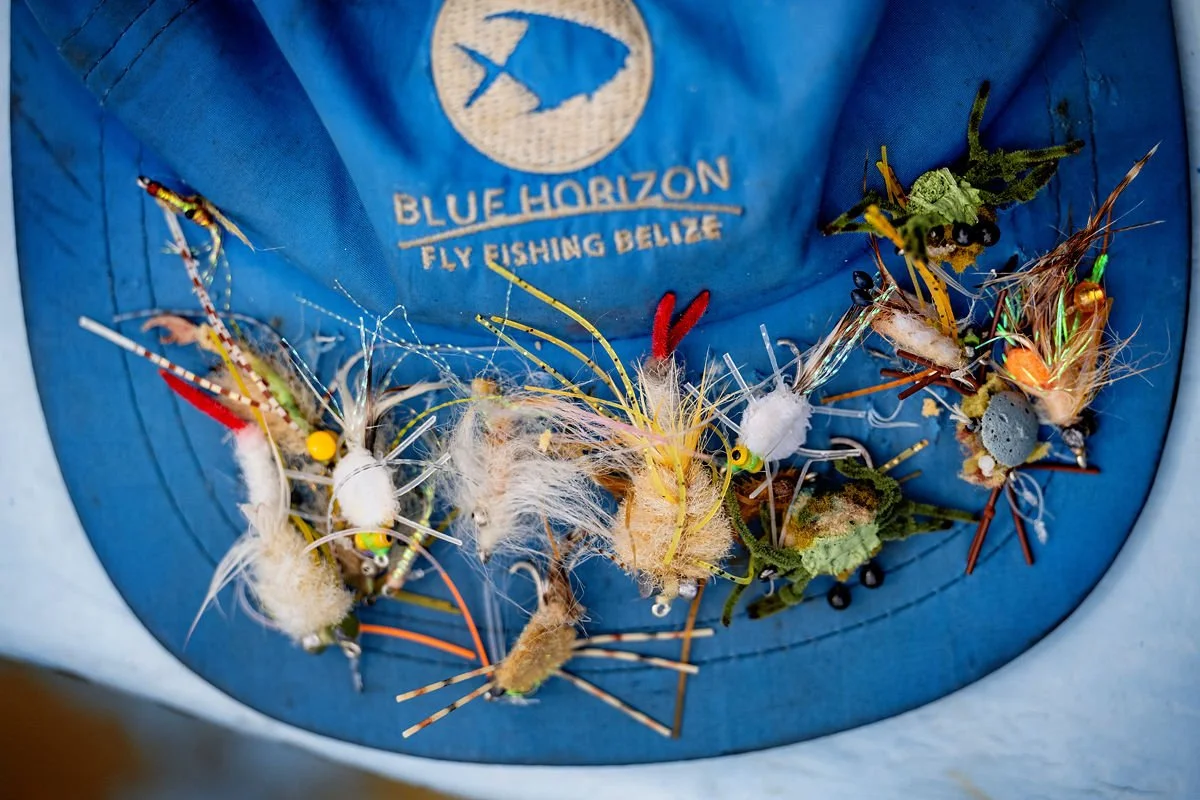
Permit are notoriously picky, but our guides swear by crab and shrimp patterns in sizes 2–8 with enough weight to get to the bottom quickly. Top producers include:
Bauer's Crab: Olive and Tan (sizes 6–8). This is a classic fly for permit and was developed by Lincoln Westby and his close friend Will Bauer, in this fishery.
Camo Crab: Olive (sizes 2). Can only be purchases at https://ssflies.com/product/camo-crab/
Colby’s Casa Blanca Raghead Crab: Tan (size 4-8). This fly has evolved into one of the guide’s favorites.
Other favorites: Merkin, Alphlexo (smallest sizes), Avalon, Contra Band Crab, Mantis Shrimp, and Kung Fu Crab.
-
For tarpon, you want unweighted or lightly weighted baitfish patterns on large, strong hooks (sizes 1/0 to 4/0). Dark colors generally work best: purple and black or black and red, while brighter colors: Red and White or Chartreuse can work well when the dark colors are not working. Must-haves include:
Toads & Bunnies: Tarpon Toad, Tarpon Bunny
Classics: Black Death, Cockroach, Deceivers, and Clouser Minnows
Baitfish profiles: Gummy Minnows (sizes 2 to 2/0) and Apte-style flies.
-
Bonefish in Belize love smaller shrimp and crab patterns (sizes 4–10) with medium weight. Bring a variety of colors like white, pink, tan, and olive. Our go-to flies are:
Christmas Island Special: white, tan, or pink
Crazy Charlies: Chartreuse, white, pink, and brown. Rubber legs are a bonus.
Gotchas: White, pink, and tan. Rubber legs are a bonus.
Pops' Bonefish Bitters: Olive and amber
Other favorites: Bonefish Slider, Pink Puff, and Meko Special.
-
While we have a complete line of Orvis equipment available for rent, anglers bringing their own gear should pack the following:
Rods: An 8 weight for Bonefish (an 8 wt is also great for permit when there is little or no wind, as the lighter fly line lands softer on the water, and is less likely to spook permit), an 8–10 weight for Permit (10 wt is ideal for fighting the wind and the fish), and an 11–12 weight for Tarpon.
Reels & Line: Saltwater-specific large arbor reels with a sealed drag and at least 200 yards of backing. Pair these with tropical weight-forward floating lines for bonefish and permit. For tarpon, a sink-tip line (350–550 grains) is highly recommended for fishing the deeper channels. From time to time, an intermediate sink tip line is needed for permit and/or tarpon.
Apparel: Lightweight, quick-dry long-sleeve shirts and sun hoodies, a baseball cap or wide-brimmed hat, and a Buff for sun protection. A packable rain jacket is essential for cool mornings and occasional passing showers.
Footwear: Because our guides frequently wade-fish for tailing permit, hard-soled flats boots (like those from Simms, Patagonia, or Orvis) are highly recommended to protect your feet from coral and rocks. We like the easy on/off neoprene zip up style booties.
Eyewear: Two pairs of high-quality polarized sunglasses (amber, copper, or green mirror lenses) so you always have a clean, salt-free pair ready for spotting fish.
-
The tide cycle is a critical factor for flats fishing success, and tides are dictated by the moon. Generally, the days leading up to and immediately following a new moon and full moon provide the strongest tidal movements. Strong moving water pushes crabs, shrimp, and other permit food, across the flats, which triggers active feeding. Our guides track the tides daily to put you on the flats during optimal water movement, regardless of the moon phase. The new moon and full moon phases offer the longest opportunity for ‘rushing’ water across the flats during the day, but there will be ‘rushing’ water for shorter durations during the other moon phases.
-
You can catch tarpon year-round in Belize, but the size of the fish depends on the season. Belize has a very healthy population of resident tarpon (typically ranging from 5 to 40 pounds) that live in the mangroves, channels, and lagoons 365 days a year. From late April through early September, the massive migratory tarpon (ranging from 70-120 pounds) pass through our waters. If you are specifically hunting a 100-pound silver king, summer is your best window.
-
Wading is not strictly required, but being willing and able to wade significantly increases your chances of catching a permit. Southern Belize and "Permit Alley" are famous for their hard-bottomed coral "pancake flats." While our guides often pole the skiff to spot fish, once a tailing permit is located, sometimes the most effective strategy is often to slip quietly out of the boat and stalk the fish on foot. We highly recommend bringing purpose-built, hard-soled flats boots for this exact scenario.
-
Fishing in a tropical environment means weather can be unpredictable. While rare, tropical disturbances can occur. If a passing squall or rainstorm rolls through, it usually passes quickly, and our guides will navigate to leeward islands or protected mangrove channels to keep you fishing. If the weather creates unsafe boating conditions, the lodge manager and head guide will make the call to delay departure until it is safe. The same is true for day trips from Placencia, Hopkins, or one of the Muy’ono Resorts, if the seas and weather conditions are unsafe to go fishing, we will attempt to reschedule your fishing tour to another time.
-
We recommend a 9-weight or 10-weight fly rod for permit in Belize. While a 9-weight offers a softer, more delicate presentation for calm days, the 10-weight is often the better all-around choice because there is almost always a steady ocean breeze on the flats. The extra backbone of an 10-weight helps you punch your fly through the wind and turn over heavier crab patterns accurately. If you have both, we recommend taking both with you on the boat, rig one with a crab pattern (Camo crab) and the other with a shrimp fly for permit (Colby’s Casa Blanca in tan).
-
If you only bring one pair of sunglasses, we highly recommend copper, amber, or bronze lenses. The flats in Belize are a mix of white sand, turtle grass, and coral. Copper and amber lenses provide the highest contrast in these environments, making it much easier to spot the subtle silver flash of a bonefish or the dark sickle tail of a permit. Green mirror lenses (which often have an amber base) are also excellent. We suggest avoiding blue mirror or gray lenses, which are better suited for deep, open-ocean water.
-
For bonefish and permit, you should use weight-forward, tropical floating lines. It is critical that your line has a tropical core; standard cold-water trout lines will wilt, stick to the rod guides, and turn into a tangled mess in the Belizean heat. For tarpon, we recommend bringing a heavy sink-tip line (most of our tarpon tend to be found holding deeper in deeper water). A 400-500 grain Leviathan from Rio is the perfect tool for the job.
-
"Permit Alley" is what of the local guides call on specific flat. That flat is more widely know as “Permit Paradise” or simply Paradise. Permit Alley has evolved to reference the flat from Placencia to Dangriga, Blue Horizon Lodge in located as close to the center of this region as possible. This area features a unique geological formation of hundreds of hard-bottomed coral "pancake flats" surrounded by deeper water permit crave for safety. This creates the perfect habitat and food source (crabs and shrimp) for permit. Because these flats are relatively small and numerous, it is possible to fish 15-20 (or more) flats in the same day, giving anglers more shots at permit per day than almost anywhere else in the world.
-
A pancake flat is a small, raised coral and sand plateau that abruptly rises out of deeper water, resembling a pancake (but not all are round, many are long and narrow). They are a signature feature of our fishery in southern Belize. Permit use the deeper edges of these flats as highways, swimming up onto the shallow tops with the incoming tide to hunt for crabs. Our guides will often pole the edges of these flats looking for nervous water or tailing fish, frequently anchoring the skiff so you can hop out and intercept the fish on foot.
-
The secret to catching permit isn't just about fishing at "high tide" or "low tide"—it’s about water movement. Permit can be caught at all stages of the tide cycle as long as the water is "rushing." The movement of rushing water across the flats and through the channels is what fires the permit up and gets them actively feeding on crabs and shrimp. Our guides are masters at reading these tidal movements to ensure you are in the right place when the water starts pushing.
-
Why do you use pangas instead of traditional flats skiffs? All of the guides at Blue Horizon use a Mexican-style open fishing boat called a "panga." Unlike a traditional flats boat you might see in Florida or the Bahamas, pangas have higher sides and can withstand larger waves and rougher seas. To get to the best flats in Permit Alley, our guides sometimes cross deeper ocean water where the wind can create chop. The panga allows our guides to navigate these areas safely and comfortably while still drafting shallow enough to access the skinny water. All of our guide’s boats are equipped with a lean bar/casting support.
-
Yes! All of our guide’s boats have a casting brace, casting seat, or lean bar.
-
Permit Alley is famous for its expansive "pancake flats"—shallow, wadable plateaus surrounded by deep-water edges. What makes them unique (and challenging!) is that they are often guarded on their eastern flanks by large coral heads. If you hook a large permit, its first instinct will be to run for the safety of deeper water on that eastern edge. It adds an extra element of challenge to the fight, requiring skill and quick maneuvering to keep your fly line from getting wrapped and broken off in the coral.
-
Tarpon possess a primitive lung that allows them to gulp air at the surface, which is why you will often see them "rolling" in creeks, rivers, or channels. This isn't just a cool sight—it’s an invitation! Seeing a tarpon roll gives you an exact target. A well-placed cast near where the fish just rolled often results in an explosive surface eat.
-
While Blue Horizon is unapologetically a fishing-first destination, non-angling companions who love the outdoors and enjoy solitude will have a fantastic time. Because we are situated on a private island, the snorkeling right off the lodge is world-class. We offer complimentary snorkeling gear for exploring these waters. If your companion is perfectly happy relaxing with a book, a cocktail, and a stunning ocean view while you fish, they will love it here. If they are the type of person who wants more activity choices, one of our sister resorts would be a great option. We can still offer fly fishing trips from the seaside options. Toe learn more, please visit: https://muyono.com/
-
Absolutely. Belize is incredibly accessible with direct flights from many major North American cities (Houston, Newark, Atlanta, LAX). Beyond the world-class fishing, the calm waters, snorkeling right off the island, nearby jungle adventures, and Mayan ruins make it a perfect destination for families who want to combine a serious fishing trip with a spectacular tropical vacation. Our parent company has many choices for families vacationing in Belize. Check out the website: https://muyono.com/
-
A 50% deposit is due within 10 days of booking, with full payment due 90 days prior to your trip. Cancellations must be in writing (email is perfect).
90+ Days: 100% of your deposit can be transferred or refunded (minus a 5% fee).
45–90 Days: 50% of your payment can be transferred to another date (minus a 5% fee).
Under 45 Days: Payments are non-transferable and non-refundable. We strongly encourage all guests to purchase travel insurance to protect against weather, flight delays, or unexpected events.